
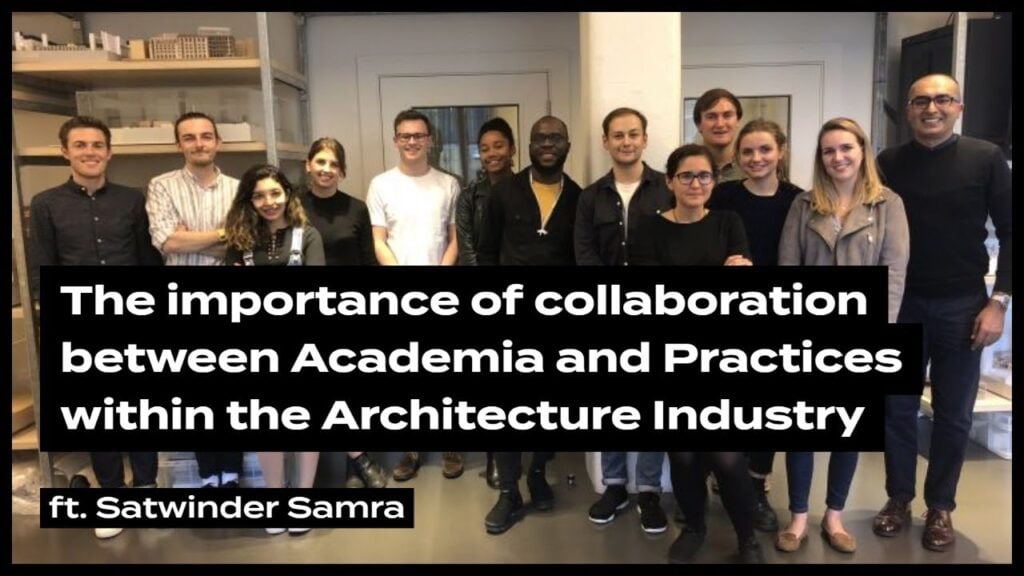
Description
In this Architecture Social CPD, Stephen Drew talks with Satwinder Samra, Director of Collaborative Practice and Senior University Teacher at the Sheffield School of Architecture, University of Sheffield, about how architecture education and professional practice can work together far more closely. It runs for roughly 32 minutes and covers the Sheffield Collaborative Practice route, what practices gain from it, and how architects can communicate their work more clearly.
Prefer audio on the move? Listen on Spotify or watch on YouTube.
Who this is for
Part 1 and Part 2 students weighing up the year out, early-career architectural assistants, practice leaders who host students, and academics who want a stronger, more intentional link between the studio and the school.
Learning outcomes
- Explain how a collaborative practice model links academic study with paid work inside an architecture studio.
- Describe what students, practices and schools each gain from an earn-as-you-learn route.
- Identify why keeping year-out students engaged across a full year benefits the practice, not just the student.
- Recognise the reasons architectural education is being questioned on length, cost and accessibility.
- Apply clearer storytelling techniques when presenting your own projects.
- Reflect on how academia and practice can build relationships that compound over time.
What Collaborative Practice actually is
Around 2015, with higher tuition fees coming in, the Sheffield team was concerned that students might drop out during the year out because architectural education is long and expensive. Their answer was Collaborative Practice: an earn-as-you-learn Part 2 route where students work four days a week in a studio and spend the fifth day on academic learning and support. The work students do in practice becomes their academic content, joining the two worlds rather than treating them as separate.
From six practices to fifty
The course launched with about six practices on board and now runs with around fifty. In a single year the team got it approved internally by the department, faculty and university, and externally by the RIBA and the ARB, while recruiting the first cohort. Satwinder is clear that the early students were pioneers rather than guinea pigs, taking a considered risk on a different way of learning.
Why the model works for students
The experience lets students reflect on what they do in practice and become more deliberate about how they make design decisions and manage their time. Instead of being passengers, they become actively engaged in the studio around them, asking better questions about why practice works the way it does.
What practices gain
The first three or four months of a year out are hard for everyone: the student is finding their feet and the practice is working out whether the fit is right. Collaborative Practice keeps the student in place beyond that settling-in period, so the practice keeps the value once the student becomes genuinely useful. Over time, alumni inside those practices start mentoring the next cohort, and the network becomes stronger and more productive.
A blended model, ahead of its time
Because students are spread across the country, the course was built around remote and blended learning from the start, with only a handful of on-campus days a year. That made the shift into remote teaching during the pandemic feel comparatively natural, even though the wider situation was difficult.
Rethinking architectural education
Satwinder argues that architectural education has not changed much in forty years and can be too long, too arduous and too expensive. Collaborative Practice is one attempt to make the route more affordable and flexible without reducing the quality of the learning. A two-year-in-practice model was developed and approved internally, though at the time it was felt to involve too much time in practice to be validated, something he suggests is worth revisiting.
Communication, storytelling and confidence
Satwinder's on-screen work on the BAFTA-winning CBBC show The Dengineers feeds directly into his teaching. His advice for presenting a project is simple: say hello and smile, tell people what the project is and where it is in the world, then walk them through how it feels to move through the space. Tap into human emotion, use plain language rather than jargon, practise what you will say, and make sure every point has a matching image on the screen.
Making architecture accessible
Running through the conversation is a commitment to inclusion and access. Coming from a working-class background, Satwinder is keen that new models acknowledge cost and open architecture up to a broader range of people, while engaging the wider public in what good design can do.
Key terms
- Collaborative Practice — the Sheffield earn-as-you-learn Part 2 route combining studio work and academic study.
- Part 1 / Part 2 — the academic stages of UK architectural education.
- Year out — the period of professional experience worked in practice between academic stages.
- RIBA and ARB validation — the professional approvals an architecture course needs to run.
- The Dengineers — the BAFTA-winning CBBC series Satwinder designs for.
Reflective prompts for your CPD record
- How could your practice or school build a more intentional link between academic learning and everyday project work?
- When you last presented a project, did you tell your audience what it is, where it is and how it makes people feel?
- What would make architectural education more accessible to people from lower-income backgrounds without lowering its quality?
About the guest
Satwinder Samra is Director of Collaborative Practice and a Senior University Teacher at the Sheffield School of Architecture, University of Sheffield. He studied architecture at Sheffield and worked in practice, including at Urban Splash and Proctor Matthews, before returning to teach. He is an on-screen designer on the BAFTA-winning CBBC series The Dengineers and collaborates with William Matthews Associates. His work champions inclusion and access across the profession.
Audio
Video
Industry
Topics
Company

People


