Description
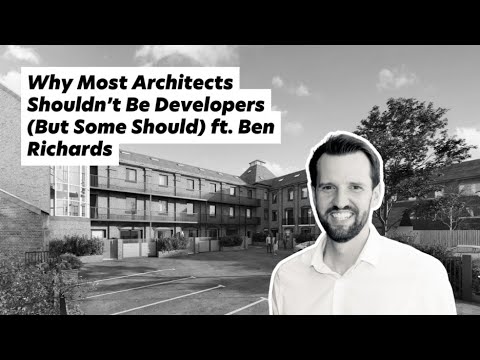
A CPD lesson with Ben Richards, founder of Aura Architecture & Interiors and XP Property. Approx. 58 minutes. Watch the video below or listen to the audio.
This lesson follows the move from architect to property developer, drawing on Ben Richards' experience of building an architecture practice, a development and investment business, a survey business and a social housing portfolio at the same time. It is candid about the risks as well as the opportunities.
Who this is for
Architects and architectural assistants weighing a move into development, anyone running or setting up a small practice, and designers who want to understand where the commercial value sits across the wider property life cycle.
Learning outcomes
By the end of this lesson you will be able to:
- Explain why design is only one part of the property development life cycle, and what the other parts demand.
- Describe how building a team and working on the business, rather than in it, lets a small practice grow.
- Recognise the real economics and risks of development, including finance costs and personal guarantees.
- Identify where permitted development and commercial-to-residential conversions create opportunities.
- Use AI and survey technology to take low-value tasks out of your workflow.
- Apply a "survive to thrive" mindset and open team communication inside a small practice.
1. Design is one piece of a much bigger puzzle
The most common misconception architects carry into development is that design is the value-adding step. It adds value, but it is a small part of the cycle. You also have to find the opportunity, fund it, structure the deal, manage utilities and community infrastructure levies, and sell the finished units. Ben's role in his development business is design and delivery, while his business partner leads land and acquisition.
2. Build a team and work on the business
Ben set up his architecture practice with the explicit goal of removing himself from day-to-day delivery so he could pursue development. He hired an assistant and a Part 2 architect early, and recommends the principle of "who, not how": decide who to delegate to rather than how to do everything yourself. You cannot operate a business and grow it at the same time.
3. Hiring well in a small practice
Recruitment is where small businesses lose the most time and money. One underperformer in a team of five drags down far more than their own salary, through delayed projects and the time others spend covering. Ben's approach is to hire slowly and act quickly when it is not working, use the probation period with monthly reviews and development plans, and set a task in the process that tests the actual job rather than interview polish. He also uses personality profiling to understand the person behind the role.
4. The real economics and risk
Development is not printed money. Finance costs eat profit every month a scheme sits unsold, and a project that should clear a healthy margin can end up at a fraction of it if the sale runs months late. Developers also carry significant debt and often personal guarantees, with their own home potentially on the line. Cash flow, not headline profit, is what keeps a property business alive.
5. Residential, commercial, HMOs and leases
Vanilla buy-to-let has become hard to make work, squeezed by regulation and rising costs. Houses in multiple occupation yield more because they are let by the room, but they are the hardest assets to manage and carry heavier regulation. Commercial property and social housing are often let on longer, full repairing and insuring leases, where the tenant takes on repairs and maintenance, which is part of their appeal to investors.
6. Planning is the biggest bottleneck
Ben is blunt that the planning process is the largest blocker to delivering homes. Committees can be slow and unpredictable, and the volume of supporting reports now required, much of which arguably belongs to building regulations rather than planning, adds cost and delay. He also notes that the green belt is widely misunderstood: it includes disused petrol stations, old airfields and hard standing that could be developed in already sustainable locations.
7. Social housing and commercial-to-residential conversions
Two clear opportunities stand out. Social housing demand is enormous and here to stay, though affordable-housing requirements on larger schemes can make sites hard to stack up. And permitted development, including Class MA, allows many commercial, office and some retail spaces to be converted to residential within a defined determination period, far faster than a full planning application. A large share of Ben's current pipeline is some form of commercial-to-residential conversion.
8. Retail, industrial and the high street
Industrial and logistics space has grown strongly on the back of online retail and fulfilment, while traditional retail has been under pressure for years. Ben sees opportunity in repurposing the high street: smaller, more affordable ground-floor retail with disused upper floors converted into homes, which brings residents back into town centres and supports the shops below.
9. AI and survey technology
Ben treats AI as a way to remove low-value work, from research and data entry to first-draft images, and points to space-planning tools that can generate layout options against a set of constraints in seconds. On the survey side he contrasts professional laser scanning, which produces a highly accurate point cloud digital twin, with phone-based LIDAR and Matterport tours that are less accurate but increasingly fit for purpose, sharing site information with structural engineers and clients without a site visit.
10. Sustainability, interiors and a survive-to-thrive mindset
Rising energy prices have made sustainability a live client conversation, with growing interest in heat pumps, insulation and the cost-benefit of energy upgrades; Ben's practice is building EPC and SAP understanding in-house and expanding its interior design offering. Underpinning it all is a "survive to thrive" mindset, and a belief in sharing financial performance openly with the team and collaborating with peers rather than guarding everything.
Key terms
- Permitted development / Class MA: a route that allows change of use from certain commercial uses to residential within set criteria and a defined determination period, avoiding a full planning application.
- HMO (house in multiple occupation): shared housing let by the room. Higher yield, heavier regulation and management.
- Full repairing and insuring (FRI) lease: a lease where the tenant is responsible for repairs and insurance of the property.
- Point cloud / LIDAR: a 3D digital twin of a space captured by laser scanning; LIDAR is a lower-cost scanning method now found on some phones.
Reflective prompts for your CPD record
- Of the steps in the development cycle beyond design, which do you understand least, and how would that gap affect a project you took on yourself?
- What in your current workload could you delegate or automate so you spend more time working on the business rather than in it?
- Is there a vacant commercial or retail building near you whose upper floors a permitted-development conversion could turn into homes?
About the guest
Ben Richards is the founder of Aura Architecture & Interiors, XP Property and XP Surveys, and co-host of The Property Expert Show. Episode recorded 2024. Explore the Aura Architecture & Interiors practice page and Ben's profile on the Architecture Social directory.
Video
Industry
Topics
People