
Description
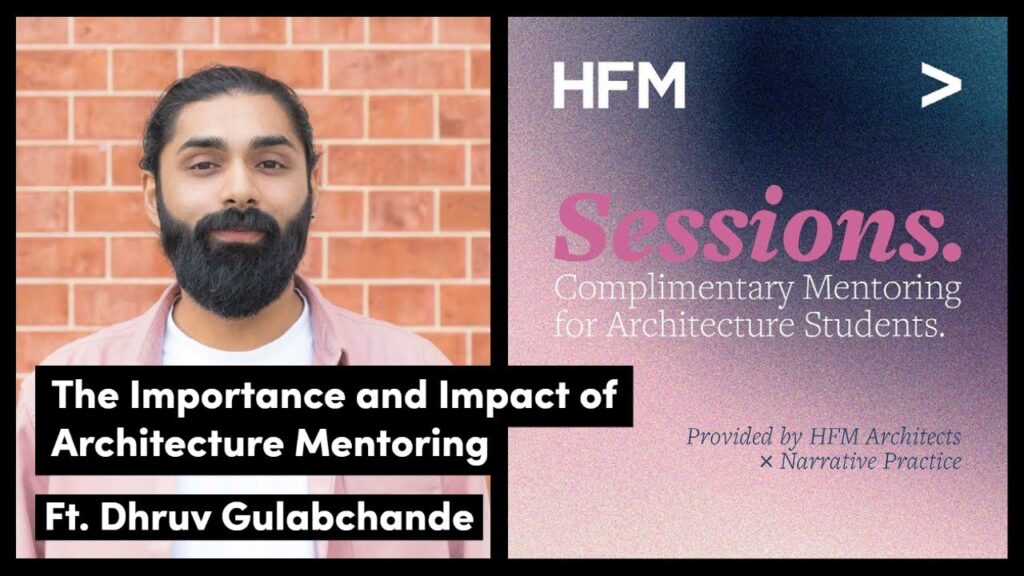
In this Architecture Social CPD, founder Stephen Drew is joined by Dhruv Gulabchande, a registered architect and Associate Director at HFM Architects and the founder of the mentoring platform Narrative Practice, for a conversation of around 45 minutes on why mentoring matters in architecture and how to build a mentoring offer that genuinely helps students.

Who this is for
Architecture and built-environment students across Part 1, Part 2 and Part 3, recent graduates navigating the move from academia into practice, and any architect or designer thinking about becoming a mentor. It is equally useful for anyone working on widening access and representation in the profession.
Learning outcomes
By the end of this session you will be able to:
- Explain why mentoring matters in architectural education and early careers, and where the gap between academia and practice tends to open up.
- Set up a lightweight, repeatable mentoring session that can work as a design tutorial, a sounding board or a friendly chat.
- Weigh in-person, online and hybrid formats and judge when each is appropriate.
- Describe the personal and professional benefits a mentor gains from the relationship, not just the student.
- Recognise common barriers to entering the profession and use bias-aware applications to widen participation.
- Signpost students to the wider network of UK built-environment collectives and mentoring initiatives.
Mentoring as the bridge between academia and practice
Dhruv frames mentoring around a specific problem: the jump from education into professional practice. Both he and Stephen describe arriving at that point under-prepared and unsure where to begin. Mentoring, done early or alongside study, smooths that transition by building confidence and practical habits before a student starts applying for jobs, rather than trying to fix everything at the point of a job search.
How Narrative Practice and its Sessions began
Narrative Practice started at the beginning of the pandemic in March 2020. With friends and family in the medical profession able to help directly, Dhruv wanted a way for architects to contribute too, and reached for an idea he had been sitting on. The mentoring scheme ran virtually for two years, helping around 150 students through roughly 250 sessions, supported by a group of close colleagues and peers. It has since evolved into in-person Sessions run through HFM Architects and Narrative Practice.
The anatomy of a session
The model is deliberately simple: a 30-minute slot, booked through a scheduling link, that can stretch to 45 minutes or an hour depending on demand on the night. The booking form captures what stage the student is at and what they want help with, so Dhruv can pair them with the right mentor in advance. He is clear that he does not do this alone, and credits a team of colleagues and friends from across his career for making the pairing and the sessions work.
In person, online or hybrid
Dhruv is honest that he has not settled on a single preference. Online was the only option during the international phase, reaching students in Hong Kong, Canada, the United States, Europe and beyond. In-person sessions build the community and the collaborative, around-the-table feel that architecture thrives on, but they exclude people who cannot travel. The pragmatic answer has been to keep a hybrid door open so that students who cannot attend in person are still accommodated.
What mentors get back
The conversation reframes mentoring as a two-way exchange. Dhruv offers three starting points for would-be mentors: genuinely caring about the students, because he was once that under-supported student himself; developing your own personable and communication skills through very different conversations; and the way mentoring experience can open doors, including into teaching and academia, which is itself under-represented. He adds, plainly, that it is also good fun.
Widening access and tackling unconscious bias
A recurring theme is representation. Dhruv and Stephen discuss bias-aware applications, including leaving profile photographs, nationality and date of birth off CVs so that decisions lean on skills. They are candid that unconscious bias affects everyone, even people who consider themselves progressive, and that seeing someone succeed who looks like you matters. Dhruv links this to a broader push to reach 16 to 18 year olds and under-represented students, including planned outreach back in his home city of Bradford.
The wider ecosystem, and the silo problem
Mentoring does not exist in isolation. Dhruv points to a network of collectives doing related work, among them the Future Architects Front, SoundAdvice, Resolve Collective and Edit Collective. The challenge, both agree, is that these initiatives are often siloed and hard to find, which is part of why the Architecture Social is building a directory to help people discover them.
Reaching the next generation
The pair compare platforms candidly. LinkedIn suits the job search and reaches working professionals; Instagram tends to reach the student demographic; and TikTok is the channel both admit they are slower to adopt but recognise they cannot ignore if they want to reach the talented young people who could enter the profession.
Key terms
- Part 1, Part 2, Part 3 - the three RIBA stages of architectural education and qualification.
- Mentoring vs tutoring - a 30-minute session can be a one-off design tutorial or an ongoing mentoring relationship that follows a student over time.
- Unconscious bias - the automatic associations that can influence hiring decisions, which bias-aware applications try to reduce.
- Widening participation - work to make architecture accessible to students from under-represented backgrounds.
- Future Architects Front (FAF) - a vocal collective representing students and early-career professionals, treated as a stakeholder by the RIBA.
- Public realm and high-street reconfiguration - Dhruv's day-to-day design focus at HFM Architects.
Reflective prompts for your CPD record
- Where did you feel the gap between academia and practice most sharply, and what support would have helped you cross it?
- If you ran a 30-minute mentoring session next week, how would you structure it and who would you want to reach?
- What is one change to your own hiring or application process that would reduce unconscious bias?
About the guest
Dhruv Gulabchande is a registered and chartered architect based in London. He is an Associate Director and Research Lead at HFM Architects, leading design-led public realm projects in the retail sector, with a focus on repurposing vacant retail stock on changing high streets. He studied at the University of Westminster and at Greenwich, and has taught as a studio tutor at the University of Brighton. He founded Narrative Practice, an architectural mentoring, design and research platform built on the idea that all spatial form is shaped by social narrative.
Listen on Spotify or watch the full conversation above, and explore more guests and practices in the Architecture Social directory.
Audio
Video
Industry
Topics
People


