
Description
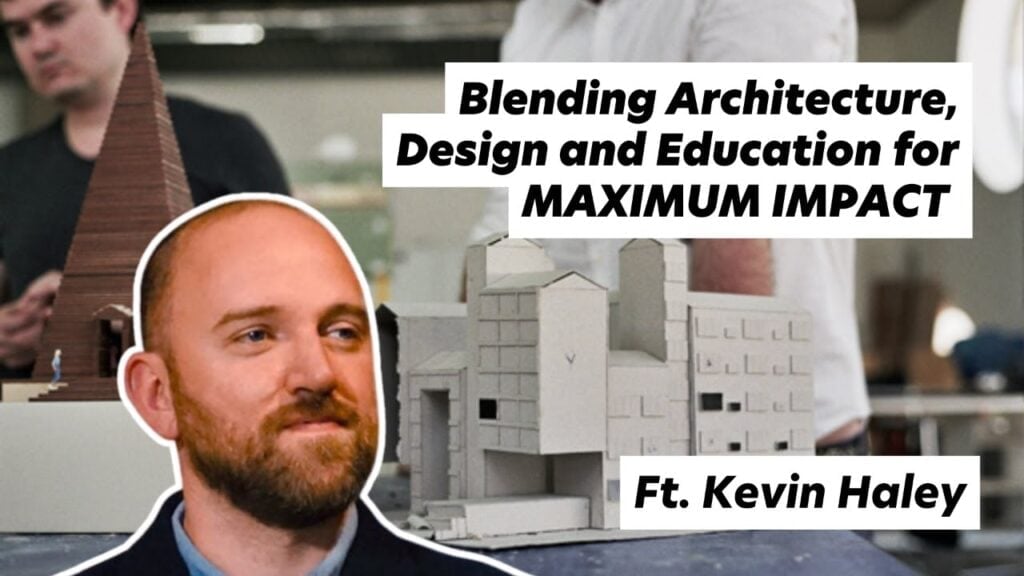
In this Architecture Social conversation (approximately 50 minutes), Stephen Drew speaks with Kevin Haley, a designer and educator who blends practice with teaching. Kevin founded Studio InPlace (formerly Kevin Haley Studio), was a co-founder of Aberrant Architecture, and teaches at the Royal College of Art. The discussion traces his route from music into design, how he built a practice through storytelling and place, and how he bridges academia and industry.
Who this is for
Students, architectural assistants, designers and educators interested in non-traditional routes through architecture and design, in placemaking and narrative-led work, in setting up a practice, or in how teaching and practice can feed one another.
Learning outcomes
- You will be able to describe how a non-linear, multidisciplinary route can lead into architecture and design.
- You will be able to explain what narrative and place-led design means in practice.
- You will be able to recognise the realities of setting up a studio, including the time it can take to win early work.
- You will be able to identify ways to engage communities directly in the design process.
- You will be able to discuss how teaching and practice can reinforce each other.
- You will be able to consider practical steps for bridging study and industry, including starting early.
From music to design
Kevin started out as a drummer in a band before moving into design. After a foundation course in Kent he studied interior design and environmental architecture at Ravensbourne, where an early enthusiasm for 3D modelling helped him find his feet, and he was recognised at the New Designers showcase.
Finding narrative architecture
His first job in practice involved technical work such as drainage and ironmongery details, which did not suit him. Discovering the narrative architecture of figures like Nigel Coates gave him a direction. He completed a Part 1 exemption through self-study and then studied a Part 2 at the Royal College of Art, which he describes as transformative.
Founding Aberrant Architecture
Kevin met his future business partner at the RCA and the pair set up Aberrant Architecture after graduating. He is candid that it took around two years of competitions and unanswered approaches before they won their first commission, a reminder that momentum in a young practice is rarely instant.
The V&A residency
During the 2010 recession the studio answered an open call and won an architecture residency at the Victoria and Albert Museum. Kevin shares the moment a panellist asked how he would engage a relative who was not interested in architecture, and his answer, to put the kettle on and have a chat, became a guiding principle: start with people and stories, then build projects from there.
The El Paso pub: a first commission
Research at the V&A into the history of public houses as places of work fed directly into the studio's first paid commission, redesigning the El Paso pub in Old Street. The team set up a small gallery in the basement, ran exhibitions and events, and used these to build relationships with design journalists, which in turn led to published work and new enquiries.
Community-led public art
Kevin describes a public art project outside Swansea Museum developed through community workshops, designing with local people rather than simply for them. Involving people in the process is something he has continued to build on.
Balancing academia and practice
Alongside practice, Kevin built a teaching career, starting by volunteering time, then teaching at Ravensbourne and London Met, where he became Head of Interior Architecture, and later at Central Saint Martins and Chelsea, and now the Royal College of Art. He sees teaching as a research tool and a dialogue with younger designers, while being honest that the early years meant over-delivering for modest pay.
Emerging technology and post-pandemic education
On the RCA platform he teaches, students are encouraged to experiment with AI as a tool rather than something to fear, and Kevin says he learns from them as much as he guides. He also reflects on how students today are more multidisciplinary and speculative, less tied to a single job title than previous generations.
Advice for students and bridging study with industry
Kevin's advice is to take risks and experiment while you have the time at university, because that freedom is hard to recover later. If you have the ambition to run your own studio, he suggests starting while you study and pushing your institution for support. He describes a meanwhile space he has set up with the RCA in Wandsworth, where students and recent graduates work on live projects, reuse construction waste from a nearby development, and meet people from commercial and business backgrounds to learn how to value and sustain their work.
Key terms
- Narrative architecture: design driven by stories, research and the meaning of a place.
- Placemaking: shaping spaces around the people and culture that use them.
- Meanwhile space: a temporary use of a site or building before longer-term development.
- Public realm: the shared, publicly accessible parts of a place.
- Residency: a funded period of research and making hosted by an institution.
- Part 1 exemption: a route to satisfying the first stage of architectural education without the standard undergraduate degree.
Reflective prompts for your CPD record
- Where in your own route have non-linear or multidisciplinary experiences added value, and how could you build on them?
- How might you involve the people who will use a space more directly in your design process?
- If you wanted to start something of your own, what is one step you could take now rather than waiting?
About the guest
Kevin Haley is a designer and educator. He is the founder of Studio InPlace (formerly Kevin Haley Studio), a London placemaking and spatial design practice, and was a co-founder of Aberrant Architecture, whose work has been shown internationally and which held the first architecture residency at the V&A. He teaches at the Royal College of Art.
Audio
Video
Industry
Topics
Company

People


