Description
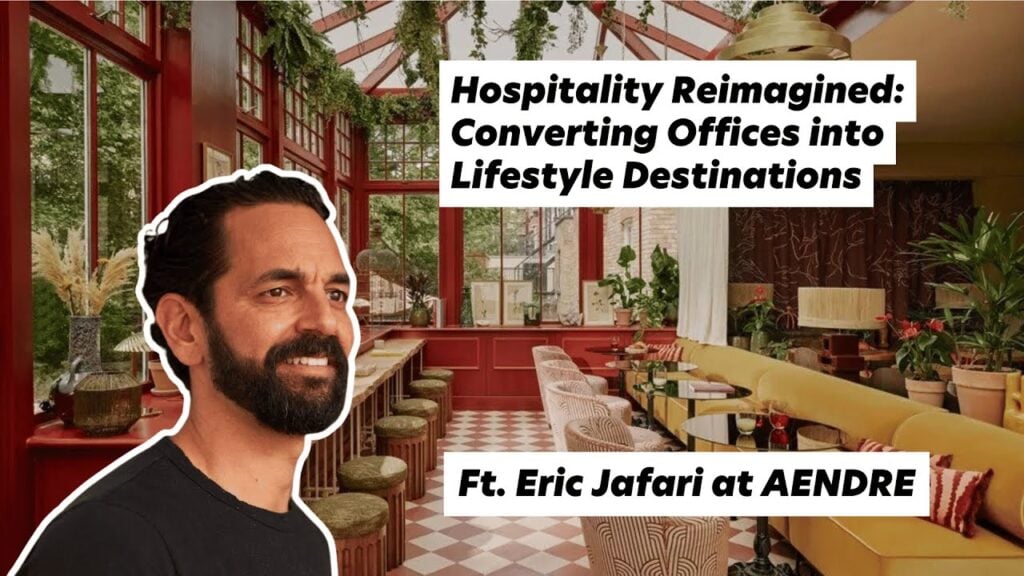
A CPD lesson with Eric Jafari, founder of AENDRE. Approx. 55 minutes. Watch the video below or listen to the audio.
Who this is for
Architects and designers working in, or moving toward, hospitality, adaptive reuse, residential conversion or mixed-use, and anyone weighing the office-to-hotel opportunity created by today's discounted office stock.
Learning outcomes
By the end of this lesson you will be able to:
- Explain why deep-plate office buildings suit extended-stay hotels better than conventional hotels or flats.
- Identify the most profitable length-of-stay and room-design decisions, and the reasoning behind them.
- Apply the "brand of one" principle to design each conversion around its building and locality.
- Recognise what hospitality developers want from a design partner, and pitch accordingly.
- Build a planning case for change of use that a local authority will support.
- Connect ESG and energy deadlines and the Gen Z wellness shift to live design opportunities.
1. From real estate to hospitality
Jafari's route in was real estate, not hotels. Studying the UK market through a US lens, he spotted a twin shortage: extended-stay rooms (hotel rooms with kitchens) and high-design lifestyle hotels. The Locke brand merged the two, "Soho House and Airbnb having a baby", and scaled to 16 properties under Oaktree and then Brookfield ownership.
2. The "brand of one" principle
The trap in branded hospitality is that your tenth hotel becomes a carbon copy of your first, which alienates the very customers who valued the disruption. The better brief is the opposite: treat every property as a brand of one, responding to its building, location, designer and food-and-beverage strategy. The building and its locality are the brief, not a set of brand standards to impose.
3. The economics of extended stay
Across 4,000 trading rooms, the most profitable guest was neither the one-to-three night traveller nor the 29-night corporate let. It was the four-to-seven night stay: a similar nightly rate to short stays, far lower servicing overhead, and almost no competitors targeting it. The design has to serve that guest, with a real gym, some co-working, good coffee, and separated sleeping and living zones.
4. Designing the room
Aim for a minimum of around 25 square metres, but how you zone the room matters more than raw area. There are 40 square metre rooms that feel more cramped than a well-designed 10 square metre micro-room. Separate sleeping from living so the space does not read as a bedroom. Counter-intuitively, the weakest design partners were often the ones with the most hotel experience, because they could not drop the hotel playbook.
5. Why offices win
Deep, awkward office floor plates are poor for prime office use and poor for conventional hotels, where the core forces either cost-prohibitive atria or windowless rooms. For extended stay, that deep plate becomes a long, skinny unit you could never afford to build new. With offices selling cheaply, there is a time-limited opportunity. The thing to avoid is a "bed farm": a building stuffed with rooms and no civic ground-floor life.
6. Winning planning
Eleven projects carried planning risk; all eleven were approved. The method: do the homework, only buy when convinced of consent, run genuine pre-application engagement, and respect that planners are people protecting a council's tax base. Two tests must hold. The office must be genuinely vacant and not re-lettable, and you must be able to sell a vision that improves the locality, with an open, local-facing ground floor and rooftop, rather than another bed factory.
7. ESG and the stranded-asset wave
UK rules require offices to meet rising energy and sustainability standards by 2030. Many London offices cannot be upgraded economically and risk becoming stranded assets. Reusing an existing building, rather than demolishing and rebuilding, is the more responsible carbon path and the commercial opening for conversion.
8. The Gen Z wellness shift
The fastest-growing guest drinks less and treats wellness as vertical and communal (high-intensity classes, sauna-and-cold-plunge socials) rather than horizontal and solitary (spa by the pool). The gym and wellness venue are becoming the new bar. The design implication is that communal wellness and co-working space, carved from those same deep plates, is now core rather than amenity.
9. Tech and personalisation
Hospitality technology is fragmented and dated. The edge goes to whoever can personalise at scale, recognising a returning guest and pre-empting their preferences, so that a mid-market product out-services a luxury one that relies on memory and goodwill.
Key terms
- Bed farm: a conversion that maximises rooms while ignoring ground-floor and civic life. The anti-pattern.
- Brand of one: designing each property around its building and locality instead of replicating brand standards.
- Horizontal vs vertical wellness: solitary spa relaxation versus communal, high-intensity, social wellness.
- Stranded asset: a building made commercially unviable by energy and sustainability compliance costs.
Reflective prompts for your CPD record
- Where in your current work are you imposing standards that the building or locality is arguing against?
- For a deep-plate office near you, what extended-stay unit could that core actually make possible?
- What would a planning case that genuinely improves the locality look like for that specific site?
About the guest
Eric Jafari is the founder of AENDRE. Episode recorded 2024. Explore the AENDRE practice page and Eric's profile on the Architecture Social directory.
Audio
Video
Industry
Topics
Company

People