Description
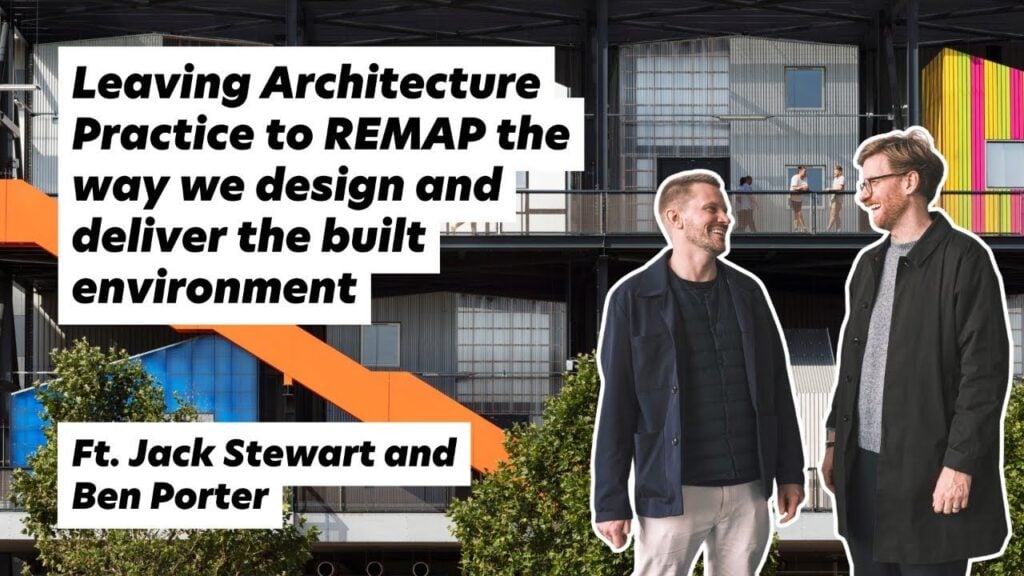
In this conversation, Stephen Drew talks to Jack Stewart and Ben Porter, the co-founders of Remap, a London based digital transformation and software development consultancy for the built environment. Both are qualified architects who spent around ten years at Hawkins\Brown before founding Remap. The episode runs for approximately 57 minutes.
Who this is for
Architects, architectural assistants and technologists who want to understand what digital design actually covers in practice. It is equally useful for practice leaders deciding how to structure a digital design team, BIM coordinators and managers looking to move into computational roles, and students considering a career that combines architecture and software development.
Learning outcomes
- You will be able to define digital design and describe its four key pillars: computational design, automation and computational BIM, software platforms, and the design to construction handover.
- You will be able to explain how a practice can structure a digital design team, including a focused software development core and a wider digital design network.
- You will be able to describe how BIM automation tools save time and reduce error, using examples such as automated conveyancing plans and custom Revit toolbars.
- You will be able to outline how initiatives such as hackathon days can surface workflow problems and build a digital culture across a practice.
- You will be able to articulate where AI is likely to add value in practice, particularly in querying building information models in plain language.
- You will be able to identify practical steps for repositioning your own career towards digital design and computational roles.
From architecture school to a digital consultancy (01:28)
Jack and Ben both studied at the Manchester School of Architecture, where the Remap atelier explored systems, mapping and how technology could be applied to the design process. Both qualified as architects and joined Hawkins\Brown a year apart, where they continued that line of work for around a decade before spinning out their own consultancy, named after the atelier that shaped their thinking.
Why they left practice to found Remap (04:15)
At Hawkins\Brown, the pair were encouraged to run research and development as a splinter team, experimenting with technologies and shaping how the practice worked. They reached a point where they felt the value extended well beyond one practice, and set up Remap to bring the same thinking to architectural practices, engineering firms and estate owners across the industry.
What digital design actually means (05:43)
The pair describe digital design as applying technology to the process of design and delivery, and break it into four pillars. Computational design applies algorithmic thinking to resolve complex geometry and push the design process. Automation and computational BIM uses scripts and routines inside BIM environments. Software platforms turn one off tools into products deployed across a practice. The fourth pillar is the interface between design and construction, where handover information can flow directly to fabrication.
Case study: a design engine for fabrication (19:20)
On the Here East gantry project overlooking the Olympic Park in London, the team worked alongside WikiHouse to deliver 21 artist studios. A design engine generated different unit forms, then produced the cutting and detail information needed by the factory at the push of a button. Each structural chassis was CNC cut, delivered flat packed and assembled with automated assembly guides, with data running from the start of design through to delivery.
Case study: mapping a campus estate (23:16)
For a large estate owner, the team mapped an entire campus on a 3D city modelling platform, overlaying its development timeline and creating views for marketing and planning. The wider point is that estate owners increasingly ask for insight rather than buildings, and understanding existing assets is a precondition for circular economy thinking.
Customising BIM: the final 10 percent (27:55)
BIM applications handle most of what a practice needs, but each organisation works differently. At Hawkins\Brown the pair built a custom toolbar of around 50 tools tied to the practice's own standards, covering everything from model validation to whole life embodied carbon calculations. By their estimate, those tools were saving the practice roughly 3,000 hours a year. One tool automatically produced 500 unique conveyancing plans for a residential scheme, a task that would otherwise be drawn unit by unit.
AI and the model as a database (37:27)
Rather than focusing on image generation, the pair see the near term value of AI in treating BIM models as databases that can be queried in plain language, opening designs up to people who cannot read drawings. Jack also points to the lack of shared data infrastructure across the project supply chain as the industry's bigger unsolved problem.
Digital design versus IT (39:15)
Digital design sits close to the design process, while IT manages hardware and software. The two need each other: digital designers act as the glue between design teams and IT, translating what designers need on projects into the right technology choices.
Building a digital culture (41:54)
Culture change runs at two levels. A practice needs a digital design strategy set by leadership, and grassroots energy from people on projects. Initiatives such as the annual Hero for a Day hackathon, where staff submit workflow pain points and a team prototypes solutions in a single day, help both levels meet in the middle.
Advice for aspiring technologists (46:29)
Their advice: spot opportunities to combine technology with the day job, choose studios and practices that embrace it, and be prepared to put your neck on the line by proposing a better way and building it. Tools usually take longer than expected, so have a backup plan, but the investment compounds every time the process runs again.
Key terms
- Digital design: applying digital technology to the process of designing and delivering buildings.
- Computational design: using algorithmic processes to resolve geometry and drive design decisions.
- Computational BIM: scripting and automation inside BIM environments such as Revit.
- Design to construction handover: passing structured design data directly to contractors and fabrication machinery.
- BIM model as a database: treating the information in a model as queryable data rather than just drawings.
- Hackathon: a focused sprint where teams prototype solutions to nominated workflow problems.
Reflective prompts for your CPD record
- Which repetitive task in your current workflow costs the most time, and what would an automated version need to do?
- How does your organisation connect its design teams and IT function, and where does responsibility for digital design sit?
- What one digital design problem could you solve and explain clearly in your portfolio or next review?
About the guests
Jack Stewart and Ben Porter are the co-founders of Remap, a London based consultancy providing digital transformation and software development services to the built environment industry. Both are qualified architects who studied at the Manchester School of Architecture and spent around ten years at Hawkins\Brown, where they established the practice's digital design team before founding Remap in 2023.
Audio
Video
Industry
Topics
Company
People