
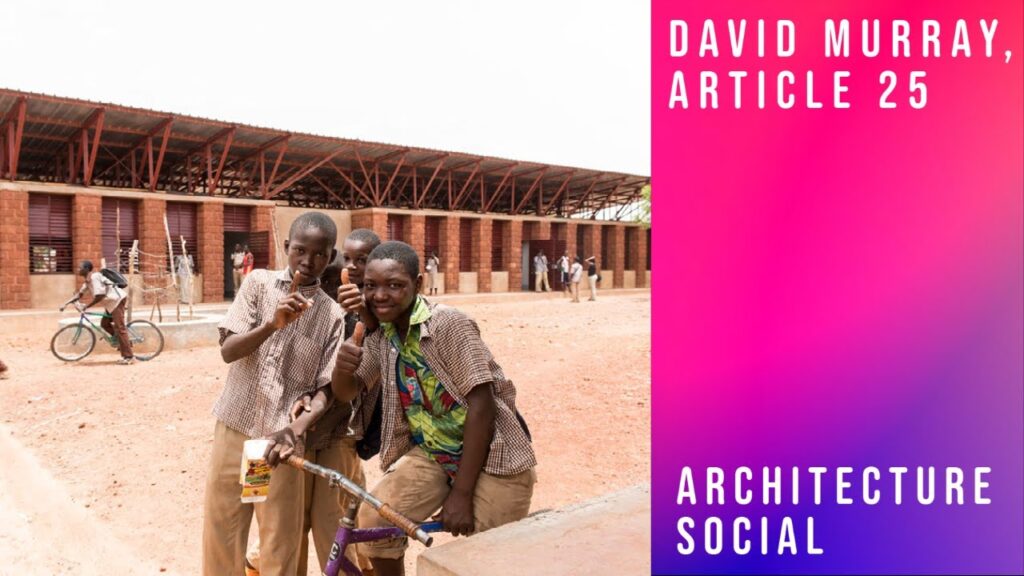
Description
In this Architecture Social conversation (around 39 minutes), Stephen Drew speaks with David Murray of Article 25, the UK's leading architectural humanitarian NGO, about what it means to use built environment skills for humanitarian impact. Article 25 takes its name from Article 25 of the United Nations Universal Declaration of Human Rights, the right to adequate and dignified shelter, and applies professional design and delivery to schools, hospitals and homes in some of the most challenging settings in the world.
Who this is for
Part 1 and Part 2 architectural assistants weighing up humanitarian and voluntary experience, early-career professionals looking to stand out in a competitive market, and any built environment professional curious about how design skills translate into social impact. It is also useful for practices and individuals considering how to support humanitarian architecture through funding, volunteering or awareness.
Learning outcomes
- You will be able to explain what humanitarian architecture is and how Article 25 links its work to the right to safe shelter.
- You will be able to describe the types of projects a not-for-profit architectural practice delivers, from schools and hospitals to post-disaster homes.
- You will be able to identify how volunteering on live humanitarian projects can build distinctive, portfolio-ready experience.
- You will be able to weigh the difference between voluntary charity experience and paid commercial work, and where each is appropriate.
- You will be able to recognise how low-embodied-energy, locally sourced materials and passive design respond to constrained settings.
- You will be able to list practical ways to support a humanitarian architecture charity beyond financial donation.
What Article 25 does
Article 25 is, in effect, a not-for-profit architectural practice based in London. It applies the same professionalism you would expect from a commercial studio, but its clients are communities in challenging settings: those recovering from a natural disaster such as an earthquake or hurricane, those long overlooked by the global aid world, or those simply facing poverty. The team designs and builds schools, hospitals and homes where they are needed most.
A studio, not a collection box
David describes a small team of around six architects, all with backgrounds in commercial architecture, leading the projects. Two founding principles, set out by past RIBA president Jack Pringle when the charity was established, still shape the organisation: first, actually do the work rather than only talk about architecture for good; and second, deliver it as professionally as any commercial project. That is why walking into Article 25 feels like walking into an architect's studio.
The projects
The conversation runs through a wide live portfolio: a school in Niamey, the capital of Niger, using laterite, a stone that can be hand-cut, air-dried and used as a low-embodied-energy construction material that helps keep classrooms cool; a hospital project in Nepal with The Leprosy Mission that serves as a general hospital as well; a preschool in Tanzania for able-bodied and disabled children alike; an orphanage in northern Tanzania; a cleft lip and palate centre in Marrakesh, Morocco with Operation Smile; a long-term hospital retrofit in Yangon, Myanmar; a new hospital on Montserrat, replacing one destroyed by volcanic activity; and the rebuilding of hundreds of homes across Dominica after hurricane damage.
Tangible impact
David contrasts humanitarian architecture with earlier roles in policy and advocacy, where impact can be hard to attribute. Build a school where none existed in a country with low literacy rates, create space for over a thousand students a year, and you can see the difference you have made. That directness is a large part of what draws people to the work.
Volunteering and career benefit
Volunteering is central to how Article 25 delivers. Opportunities exist at Part 1 and Part 2 stages, with a competitive recruitment process because the projects are so different from typical commercial roles. Volunteers receive mentoring and coaching from project architects, and the charity is well networked, often helping people move on into strong practices. David gives the example of a volunteer who moved on to HTA Design after around six months working on projects including the Operation Smile centre.
Voluntary versus paid work
Stephen draws a clear line: commercial practices delivering fee-earning buildings should pay their staff a salary. Article 25 is a different case, a charity that covers day-to-day costs such as travel and food and offers exposure to live projects rather than a salary. The value is the experience and the distinctiveness it gives a candidate. Both David and Stephen note the wish to make volunteering more accessible, and reference support such as the Stephen Lawrence Charitable Trust and RIBA schemes.
Fundraising and the 8x8 event
Fundraising underpins the charity's existence, because early feasibility work often runs at a loss before projects are funded. A flagship event is the 8x8 drawing auction, where a grid is dropped across part of London and each square inspires artworks donated by architects, engineers, artists and sculptors, then auctioned to raise funds. Other routes include t-shirt and greetings-card design competitions and regular giving.
COVID-19 challenges
Project delivery held up better than feared, though local lockdowns, border restrictions on materials and limits on workforce travel caused delays. The bigger hit was to fundraising, with large events and corporate sponsorship paused. The charity adapted with smaller-scale campaigns and appeals, including a shelter appeal in Beirut.
How to get involved
Support goes beyond donations. Sharing and raising awareness matters, as does volunteering in architecture and in communications, social media, marketing, fundraising and events. David notes that Article 25 can feel like the best-kept secret in architecture, and it should not be, given the scale of the challenge.
Key terms
Humanitarian architecture: the use of design and construction skills to improve health, education, shelter and resilience for communities in need.
Article 25 (UDHR): the article of the UN Universal Declaration of Human Rights covering the right to an adequate standard of living, including housing.
Laterite: a stone that can be hand-cut and air-dried into a robust, low-embodied-energy building material.
Feasibility study: early-stage work that tests whether a project can be delivered, often carried out before funding is secured.
Embodied energy: the total energy used to produce and transport a building material.
Reflective prompts for your CPD record
- How could humanitarian or voluntary project experience strengthen the story your portfolio and CV tell an employer?
- Where in your own work could locally sourced, low-embodied-energy materials or passive design reduce environmental impact?
- What is one practical way you could support humanitarian architecture in the next year, through skills, awareness or giving?
About the guest
David Murray works at Article 25, the London-based architectural humanitarian NGO, and describes himself as the only non-architect in a team otherwise made up of architects with commercial backgrounds. His focus spans the charity's development, fundraising and volunteering, connecting built environment skills with communities that need safe shelter, schools and hospitals. You can find out more about Article 25 at article-25.org.
Audio
Video
Industry
Topics
Company

People


