
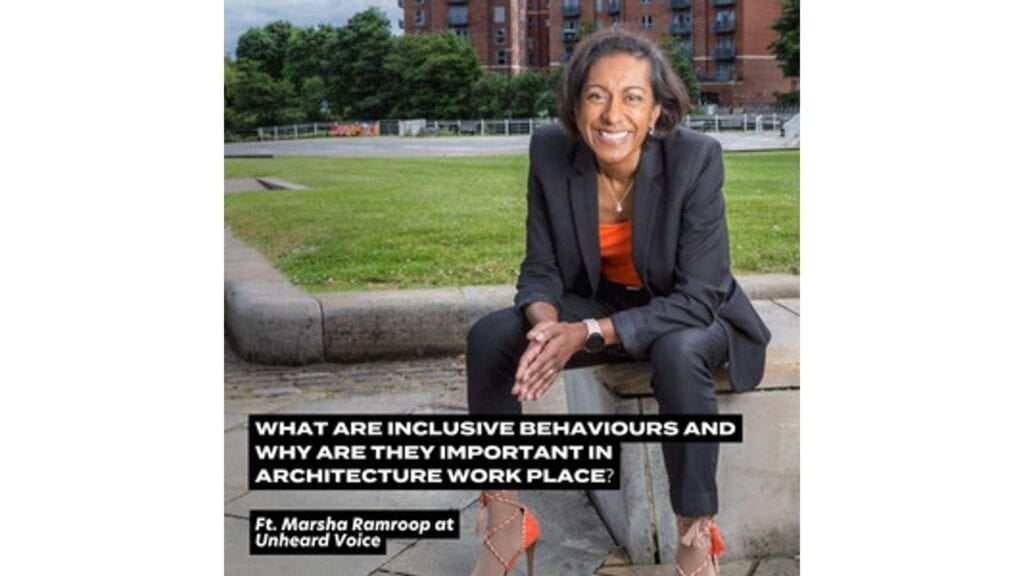
Description
In this Architecture Social conversation, Stephen Drew is joined by Marsha Ramroop, inclusion strategist and founder of Unheard Voice Consultancy, for a practical Q&A on inclusive behaviours in the workplace and what they mean for architecture and the wider built environment. Running to around 34 minutes, it is a useful primer for anyone responsible for culture, teams, design or community engagement.
Who this is for
Practice leaders, studio managers, architects and built environment professionals who want to understand what inclusive behaviours are, why they matter commercially and ethically, and how to start practising them. It is equally relevant to anyone shaping teams, designs, procurement or community engagement.
Learning outcomes
By the end of this session you will be able to:
- Explain what inclusive behaviours are and why they sit within your own control.
- Make the case for inclusion across business performance, staff engagement and ethics.
- Describe how inclusion affects attraction, retention, design quality and stakeholder engagement in architecture.
- Outline the four capabilities of Cultural Intelligence (CQ) and how they support inclusive behaviour.
- Respond to mistakes and challenge without defensiveness, using feedback to learn and improve.
- Apply inclusive thinking to design, from understanding context to community co-creation.
Inclusion starts with behaviour, not other people
Marsha frames inclusion as introspective work. It is less about other people's characteristics and more about our own behaviours: what each of us, our teams and our organisations need to change in order to include others. Because behaviour is within our control, it is also where meaningful change begins.
The case for inclusion
She sets out three reasons to take inclusion seriously: the business case, where diverse teams with genuinely inclusive cultures tend to be more innovative and perform better; staff engagement, where people who feel included are more motivated and productive; and the simple human case of treating colleagues well. She notes that inclusive behaviour does not always come naturally and often has to be learned, much like other professional skills.
Why it matters in architecture
Marsha breaks the relevance to architecture into four parts: attracting a broader range of people into the profession; treating, progressing and retaining them once they are in; producing more inclusive design; and engaging clients, communities and procurement well. Inclusion, she argues, underpins all four.
Developing inclusive behaviours
The starting point is motivation: genuinely wanting to be inclusive, and staying curious and persistent rather than defensive. Marsha is candid that everyone gets things wrong, including her. The skill is to acknowledge the mistake, listen to the feedback, reflect, and resolve to do better, then keep practising. She references Timothy Wilson's work on the adaptive unconscious and the idea that changing behaviour can be a route to changing mindset.
Cultural Intelligence (CQ)
Cultural Intelligence is defined as the capability to work and relate effectively with people who are different from you. Marsha describes it as a capability that can be developed rather than a fixed trait, measured as CQ, and built on four capabilities: drive, knowledge, strategy and action. Developing these, and acting on feedback, is how inclusive behaviour becomes more natural.
Where inclusion fits into design
For Marsha, a truly inclusive architect understands the context before putting pen to paper: visiting the site, observing how spaces are used, and talking to local people and businesses. Listening to different lived experience can change a design for the better and, practically, can help a project through planning with fewer objections. She highlights how the spaces we build shape how people relate to one another.
Responding to objections
Inclusive engagement does not mean pleasing everyone. It means listening, anticipating concerns, and being able to explain decisions thoughtfully when you cannot accommodate every view. Handling objections with consideration is part of good community engagement.
Useful resources mentioned
Marsha points listeners to the RIBA Inclusive Design Overlay and the RIBA plan of work overlay on spatial justice (co-design) as practical tools, alongside her own writing and thought leadership at unheardvoice.co.uk. She also shares an example of advising built environment professionals on rebuilding inclusively after conflict, illustrating how inclusive thinking applies even to reconstruction.
Key terms
- Inclusive behaviours: the actions, within your control, that make it easier to include others, whoever they are.
- Cultural Intelligence (CQ): the measurable capability to work and relate effectively across difference, built on drive, knowledge, strategy and action.
- EDI: equity (or equality), diversity and inclusion.
- Adaptive unconscious: the large amount of information our brains process below conscious awareness, which is part of why bias is human.
- Inclusive design: designing places that work for the widest possible range of people, supported by tools such as the RIBA Inclusive Design Overlay.
Reflective prompts for your CPD record
- What is one behaviour of my own that I could change to be more inclusive of colleagues or clients?
- Where in our attraction, retention, design or engagement process is inclusion weakest, and what is one step to improve it?
- How do I currently respond when I am challenged on inclusion, and how could I respond more openly?
About the guest
Marsha Ramroop is an inclusion strategist and founder of Unheard Voice Consultancy, where she helps organisations in architecture and the built environment improve culture using Cultural Intelligence. She is a qualified Cultural Intelligence practitioner and was previously the Director of Inclusion at the Royal Institute of British Architects (RIBA), following a career as a BBC journalist and editor.
Audio
Industry
Topics
Company

People


