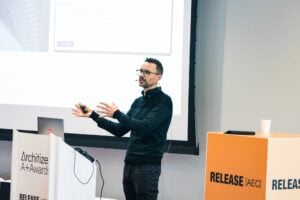
Description
A CPD lesson with Allister Lewis, founder of ADDD (Automated Data Driven Design), on BIM 2.0, AI and the future of architecture technology. Approx. 69 minutes. Listen to the audio below.
Who this is for
Architects, architectural assistants, BIM managers and practice leaders who want to understand how AI, BIM 2.0 and a new generation of software are changing day-to-day work, and anyone weighing a move from traditional architecture into a technology-focused role.
Learning outcomes
By the end of this lesson you will be able to:
- Explain what BIM 2.0 means and how the latest web-based tools differ from file-based software such as Revit.
- Describe how generative design and early-stage feasibility tools are reshaping the front end of projects.
- Map the wider AEC software landscape across visualisation, compliance, knowledge management and administration.
- Assess your practice's digital foundations, from data and IT spend to workflows, before adopting new tools.
- Recognise emerging roles such as BIM manager, computational designer and digital design lead, and where they sit.
- Identify practical routes for architects to pivot into the software side of the industry.
1. From architect to digital design lead
Allister qualified as an architect in 2007 and worked in multidisciplinary public-sector teams at Portsmouth City Council and Hampshire County Council. He moved into BIM management delivering primary schools on Revit during the early years of the UK BIM mandate, then into a head of technology role covering hardware, software, infrastructure, workflows, training and research, a remit now often called digital design lead. A later consultancy role in computational design and software integrations led him to found ADDD.
2. What BIM 2.0 means
BIM 2.0, a term popularised by Martin Day in the AEC press, describes a new wave of software that works very differently from traditional, file-based, locally installed tools such as Revit, MicroStation, AutoCAD, ArchiCAD and Vectorworks. The newer tools tend to be web-based, collaborative and interoperable. A useful reference point is the Future AEC Software Specification, drawn up after architects in Scandinavia, the UK and the US wrote to Autodesk about the lack of progress on Revit. Its ten points describe what good software should look like, including being web-based, collaborative, interoperable, AI-enabled where appropriate, and built with data privacy and sustainability in mind.
3. Generative design and feasibility
One of the clearest shifts is in early-stage feasibility, where generative design tools are taking over work that Revit handles only clumsily. Allister has reviewed around forty generative and early-stage tools and published a report scoring them against the Future AEC Software Specification. Maturity varies widely: some tools are well funded and ready for practice use, while others are very early stage. Because most are sold as subscriptions, practices can trial a tool for a month and move on if it does not fit, a flexibility the old licensing model rarely allowed.
4. The wider software landscape
Beyond design, the landscape splits into several overlapping areas: AI for administrative tasks, AI for visualisation and rendering, computational design, task and project management, and sustainability tools for whole-life carbon and life-cycle assessment. Allister maintains a database of more than 1,700 AEC tools, many of which are hard to find through ordinary search because the large vendors dominate the obvious terms. A tagged, categorised directory makes it possible to find niche tools by what they actually do.
5. AI in 2026
Allister expects several areas to grow quickly: compliance software that checks drawings against regulations; automated drawing tools that generate dimensions, grids and tags from a model and could compress detailed design from months into weeks; and knowledge management that helps practices use the data they already hold. He also points to low-code and AI-assisted coding, which let practices build small, specific plugins and apps rather than relying solely on off-the-shelf software.
6. Get the digital foundations right
Before chasing the newest tool, Allister argues for fixing the foundations. His technology strategy programmes repeatedly find fragmented data, ageing or unpatched IT infrastructure, and significant overspend on outsourced IT support. Reducing that waste frees budget for the tools that actually improve design. The work also covers backup, secure remote working and cyber basics, alongside a clear map of how each team really works from beginning to end.
7. The new roles
The titles BIM manager and BIM coordinator are now well established, and the digital design lead is emerging as the next step up: someone who combines BIM knowledge with infrastructure, software, AI and the leadership skills to take a practice on a journey. Computational design is harder to pin down as a job title, often bundled with design roles, which can leave specialists frustrated on pay and recognition.
8. Pivoting into the software side
For architects who want to move into technology, Allister co-founded AC Tech Jobs, a board that gathers software-side AEC roles in one place, typically several hundred at a time. Product management is a strong entry point because it needs both construction knowledge and an understanding of how software is built. He has also published a free resource on becoming a product manager, with case studies of people who moved from traditional practice into software companies.
9. Redefining the architect's value
If tools make design and delivery faster, the question becomes how architects price and frame their value. Allister's view is that relationships with clients, consultants and stakeholders remain central, and that the profession should resist defining itself by design alone. Architects also bring project management, technical delivery, client advisory and asset management skills. The opportunity is to become the arbiters of this technology rather than be diminished by it.
Key terms
- BIM 2.0: a new generation of web-based, collaborative AEC software, distinct from traditional file-based tools.
- Future AEC Software Specification: a ten-point framework describing what modern AEC software should deliver.
- Generative design: software that produces and tests design options quickly, used mainly at feasibility stage.
- ConTech: construction technology, the broad category of software and tools serving the AEC industry.
- Digital design lead: an evolution of the BIM manager role spanning technology, data, AI and leadership.
Reflective prompts for your CPD record
- Where in your current workflow could a web-based or generative tool remove friction that Revit cannot?
- What are your practice's digital foundations really costing, and where would that money be better spent?
- If you wanted to move toward a digital or software-side role, what skill would you build first?
About the guest
Allister Lewis is an architect by background and the founder and director of ADDD (Automated Data Driven Design), an independent AEC technology advisory and software marketplace. He also co-founded AC Tech Jobs. Episode recorded 2026. Explore the ADDD practice page and Allister's profile on the Architecture Social directory.
Audio
Video
Industry
Topics
Company

People