
EP 01024 November 2021 · 57 min
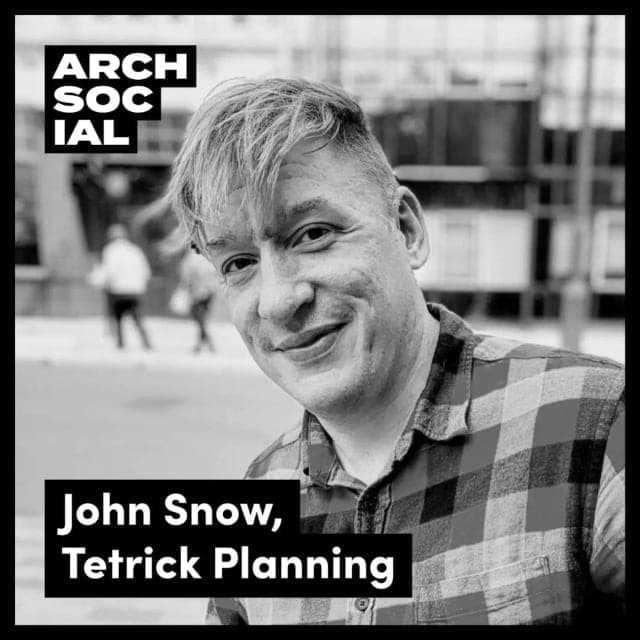
John Snow - Move aside the King in the North! This is the Prince of Planning!
 Audio · 57:13
00:00 · Introduction to John Snow and planning10 chapters ↓
Follow the showApple PodcastsSpotifyYouTubeRSS
About this conversation
John Snow - Move aside the King in the North! This is the Prince of Planning!
Planning can make or break a project, but many people outside that world only see the outcome rather than the process behind it.
Stephen Drew speaks with John Snow of Tetrik Planning about what planning consultants do, how they work with architects, Section 106 agreements, public and private sector planning experience, retail, housing and mixed-use schemes.
The conversation covers:
What a planning consultant actually does
How planners and architects work together
Why Section 106 agreements matter
Topics in this episode
Each topic opens its knowledge hub with jobs, people, courses and more episodes.
Transcript
Back to playerRead the conversation.
Automatically generated. Words and speaker labels may contain mistakes. Play a passage to hear the original.
Opening of the conversation
Every timestamp jumps to that moment in the audio.
Beep.
- · Stephen Drew
Stephen Drew
Hello, everyone.
Continue the conversation
What’s your take?
An episode ends. A good conversation carries on.
View in forum →The conversation
Loading the conversation…
The guest, the practice, the work
Follow the conversation into the directory.
Practice
Tetrick Planning Limited
Practice profile on Architecture Social.
Open Tetrick Planning Limited → EP 0257 · 84 minHe Started His Own Architecture Practice at 29Alex Sutton
 EP 0256 · 52 minWhy Architects Have Zero Power in the UK Right NowJay Morton
 EP 0254 · 78 minRunning an Architecture Practice Isn't What You ThinkTim O'Callaghan
 EP 0253 · 73 minHow to Future Proof Your Architecture CareerAmi Nigam
Roles in this world
Live Planning and Planning Consultants roles on the jobs board right now.
The newsletter
Get the next conversation in your inbox.
New episodes, the companion guides and the Friday session. No spam, unsubscribe any time.