
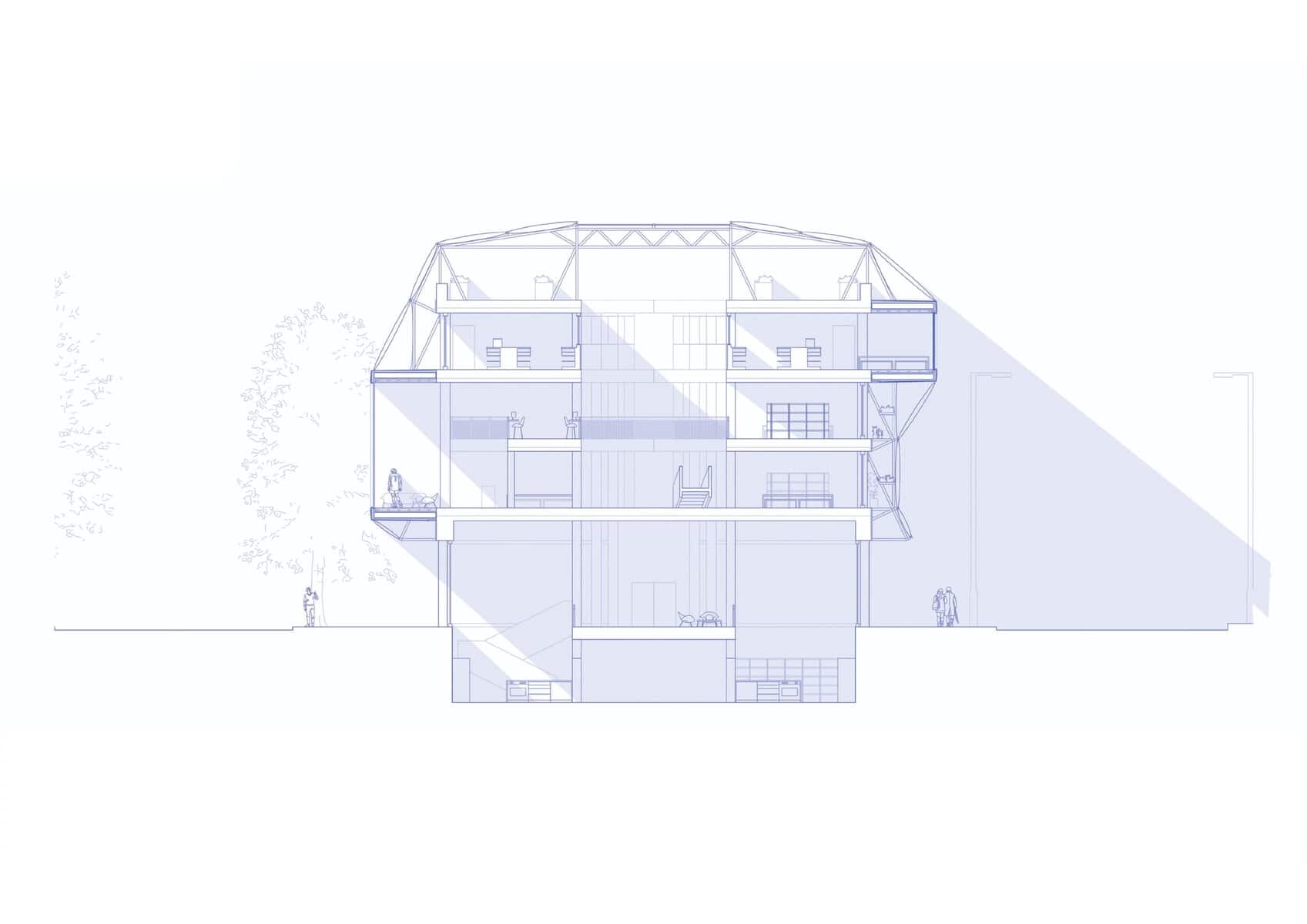
Oilean Galligan’s cookery school proposal for Shaftesbury Square in Belfast is an adaptive reuse project about food, civic life and giving an existing building a more public role.
The project keeps the former Ulster Bank Building’s concrete structure and reworks it as a cookery school where learning, demonstrations, workshops and public activity can meet on a busy city corner.
Project overview
Oilean was a Stage 3 Architecture student at Queen’s University Belfast, a World Architecture Festival Student Charette winner and a Royal Society of Ulster Architects council representative for QUB students.
The cookery school proposal uses the existing frame as the starting point, then wraps the building in an ETFE skin to create a lighter, more open civic presence. The idea is not just to reuse a structure, but to change how the corner works for people passing through Shaftesbury Square.
Adaptive reuse strategy
- Retain the concrete framework rather than starting again.
- Use a lightweight ETFE skin to bring light and visibility into the building.
- Create spaces for cookery education, demonstrations and community activity.
- Treat food culture as a civic programme, not only a private classroom use.
- Make the building feel active from the street as well as from inside.
Why the cookery school idea matters
Food is a useful programme for adaptive reuse because it brings people into contact with learning, culture and public life. In this proposal, the cookery school becomes a way to make the building social again.
Showcase an adaptive reuse project
Architecture Social can feature student projects that reuse existing buildings, protect embodied carbon and give older structures a stronger public purpose.
- Explain what the project keeps and why.
- Show the new use and the social value behind it.
- Make the material and environmental decisions easy to understand.
- Use drawings or images that show the building before, during and after the intervention.
Architecture Social view
Stephen’s recruiter view is that adaptive reuse work is valuable when it shows judgement. Practices want to see more than good intentions: they want to understand the existing fabric, the proposed use and the design decisions that connect them.
Next step
Explore more Architecture Social projects, read the portfolio guide, or submit your own project.
If this project has made you rethink your own portfolio or next move, browse current architecture jobs or contact Architecture Social for a recruiter’s view.



Add a comment