
Yash Shetty’s Living Wells gives Lewisham’s Ladywell Playtower a new civic use
Yash Shetty is a Part 2 Architectural Assistant who has recently completed his MA Architecture at Anglia Ruskin University, having previously graduated from the same school with First Class Honours in BA Architecture. His academic record is already well established, with recognition from RIBA East, Architects for Health, the RIBA Chelmsford Chapter, and the Architects’ Journal. That list matters, but the stronger point is what sits behind it. Shetty’s thesis project, The Living Wells, shows a designer working with a clear grasp of current pressures in the built environment, from retrofit and heritage to food systems, public health, and social value.
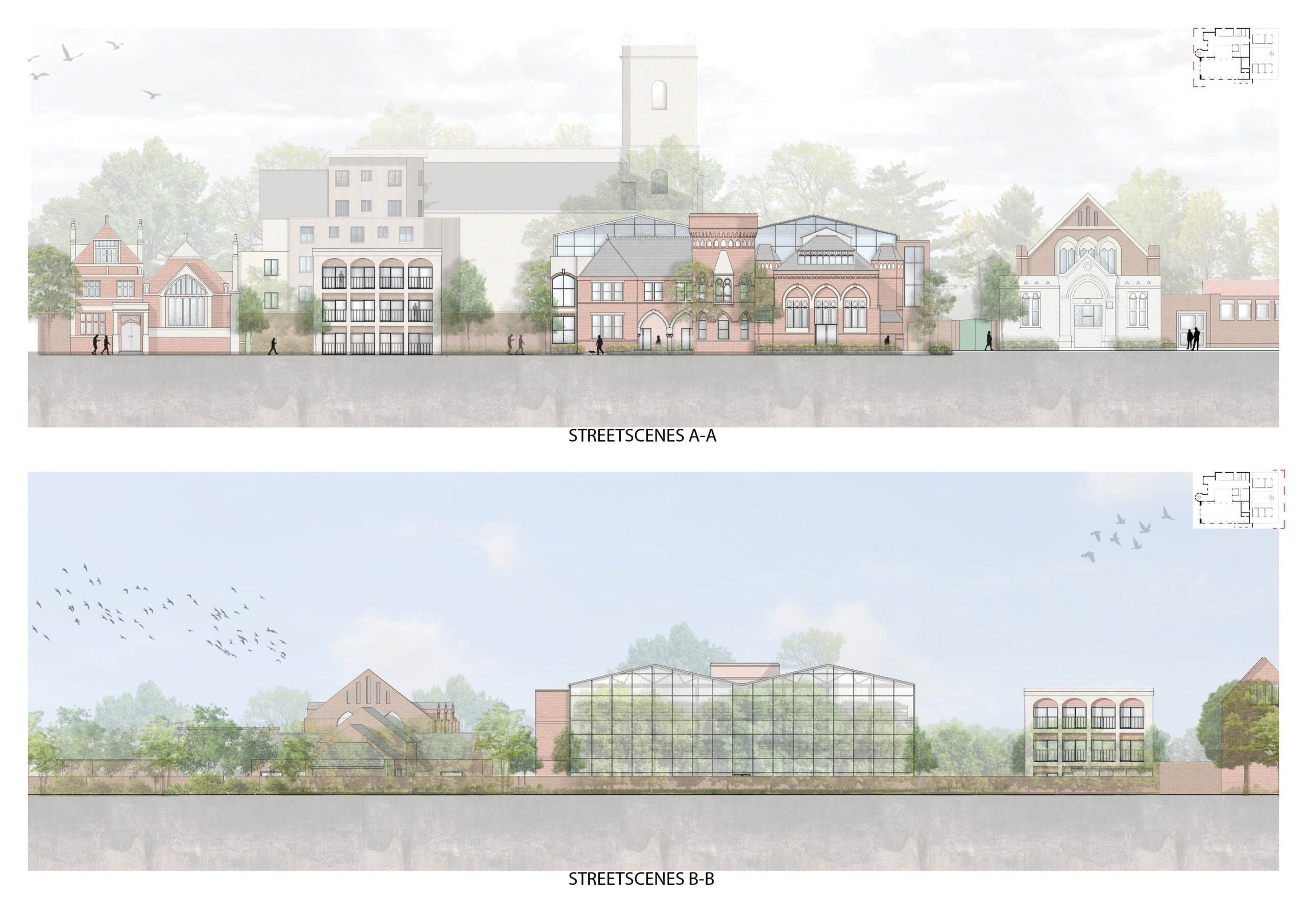
Set within the Grade II listed Ladywell Playtower in Lewisham, the project asks a direct question. What should happen to a redundant civic building when its original purpose has gone, but its public importance remains? Shetty’s answer is not a vague community use or a token cultural insertion. He proposes a productive building, one that grows food, teaches practical skills, supports social contact, and creates a place where local residents, refugees, migrants, and growers can meet through ordinary daily use.
Turning a Victorian bathhouse into food infrastructure
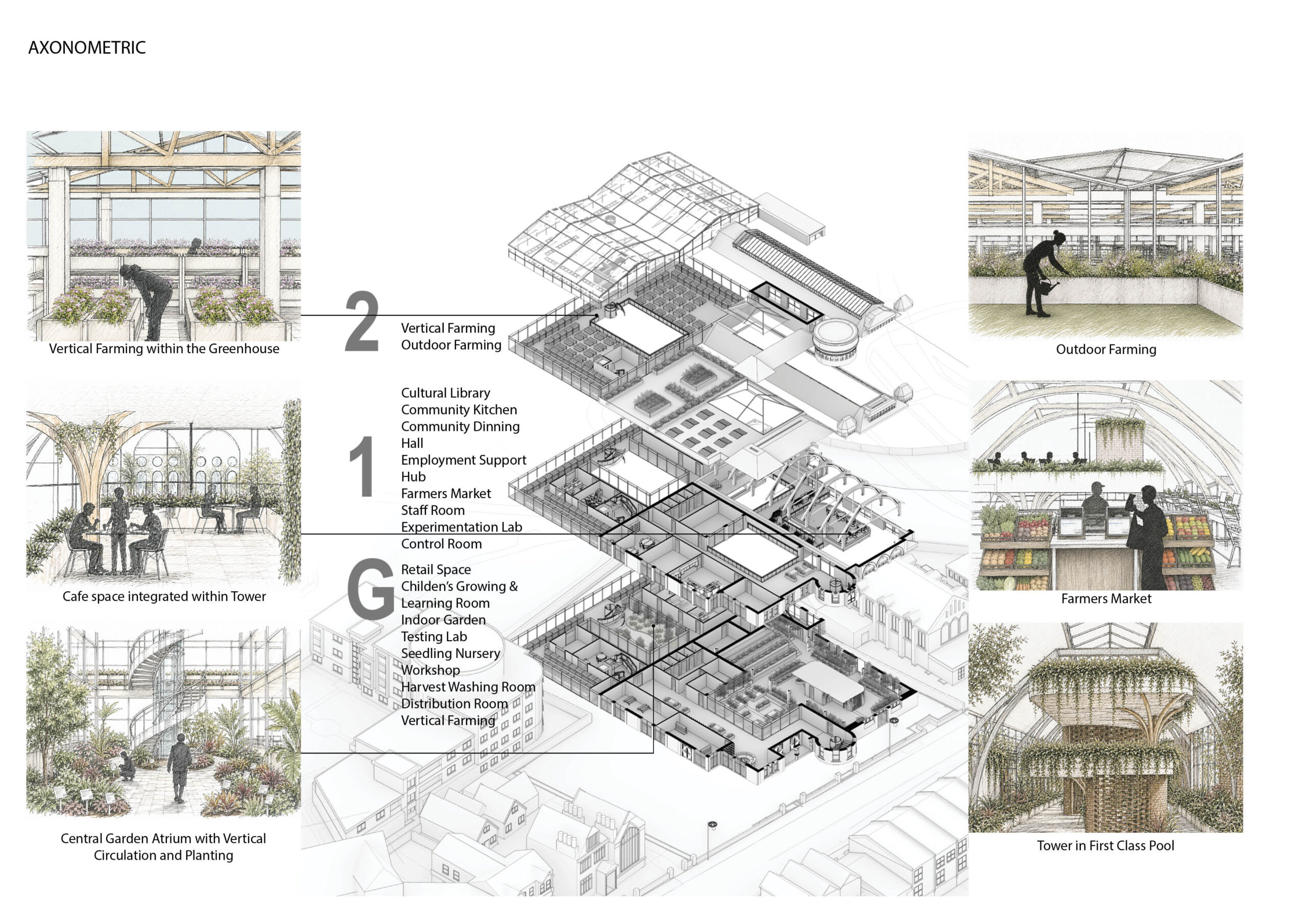
The core strength of the brief is that it treats adaptive reuse as social infrastructure rather than heritage packaging. Ladywell Playtower is not handled as a frozen artefact. It is understood as a durable urban container with enough spatial generosity to absorb a very different programme. The proposal converts the disused bathhouse into a community led food growing and learning hub, organised around vertical farming and a closed loop food system.
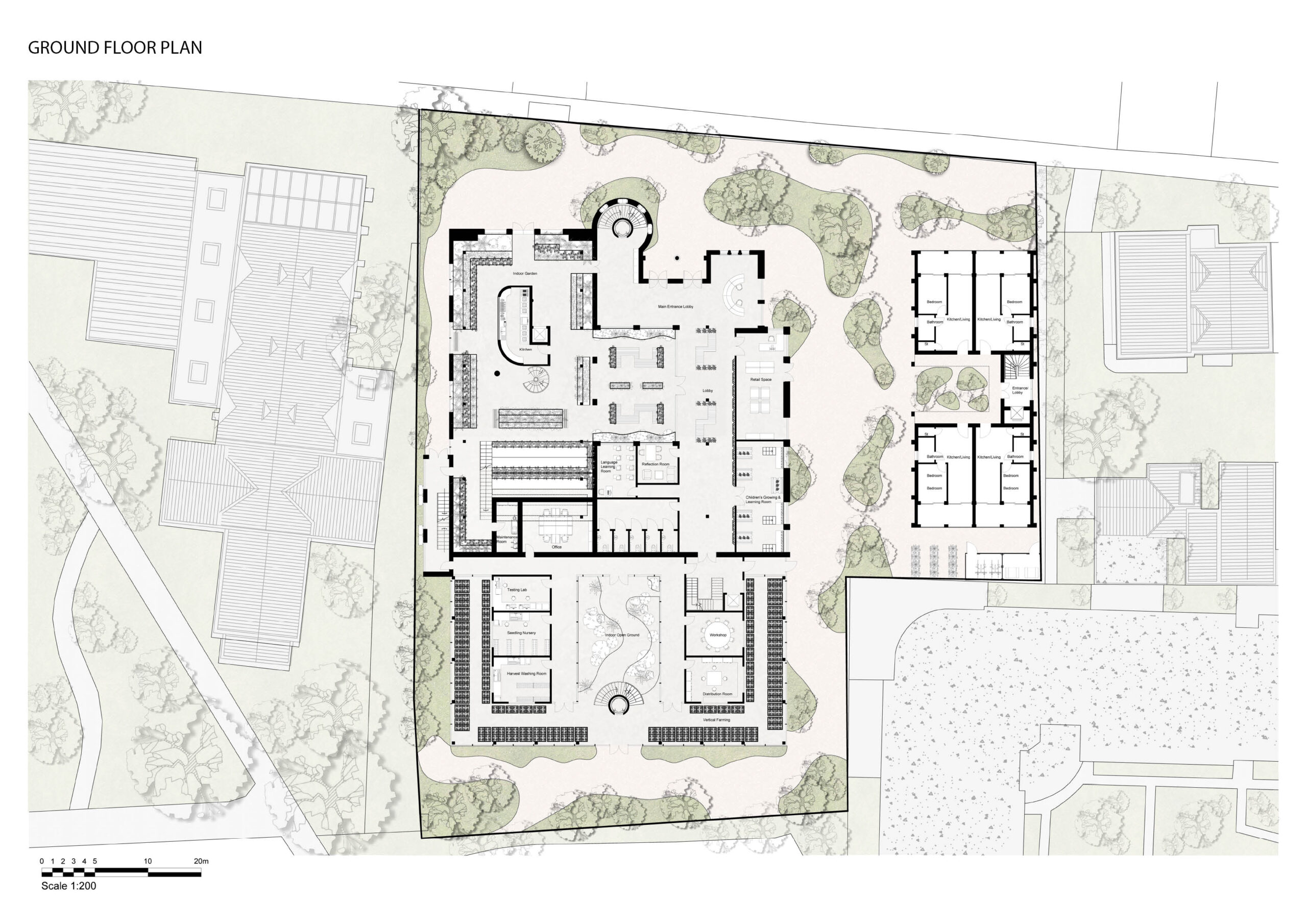
That move is timely. London boroughs continue to face pressure around food insecurity, loneliness, rising living costs, and climate preparedness. In that context, the idea of producing fresh food within a reused public building has practical weight. It also gives the project a level of specificity that many thesis schemes lack. The programme is not just socially worthy. It is spatially demanding. Food growing requires light, servicing, water management, environmental control, and reliable circulation. Public learning spaces need a different level of access, orientation, and comfort. Shetty brings those requirements together in a way that feels thought through rather than diagrammatic.
The Lewisham setting also matters. A project focused on food, integration, and public participation fits a diverse inner London context where civic buildings must work hard and serve more than one constituency. The proposal recognises that a community building cannot rely on occasional events alone. It needs repeat use, visible activity, and a reason for people to return. The combination of café, market, kitchen, workshops, and growing spaces begins to answer that.
Using the pool hall as the social centre of the scheme
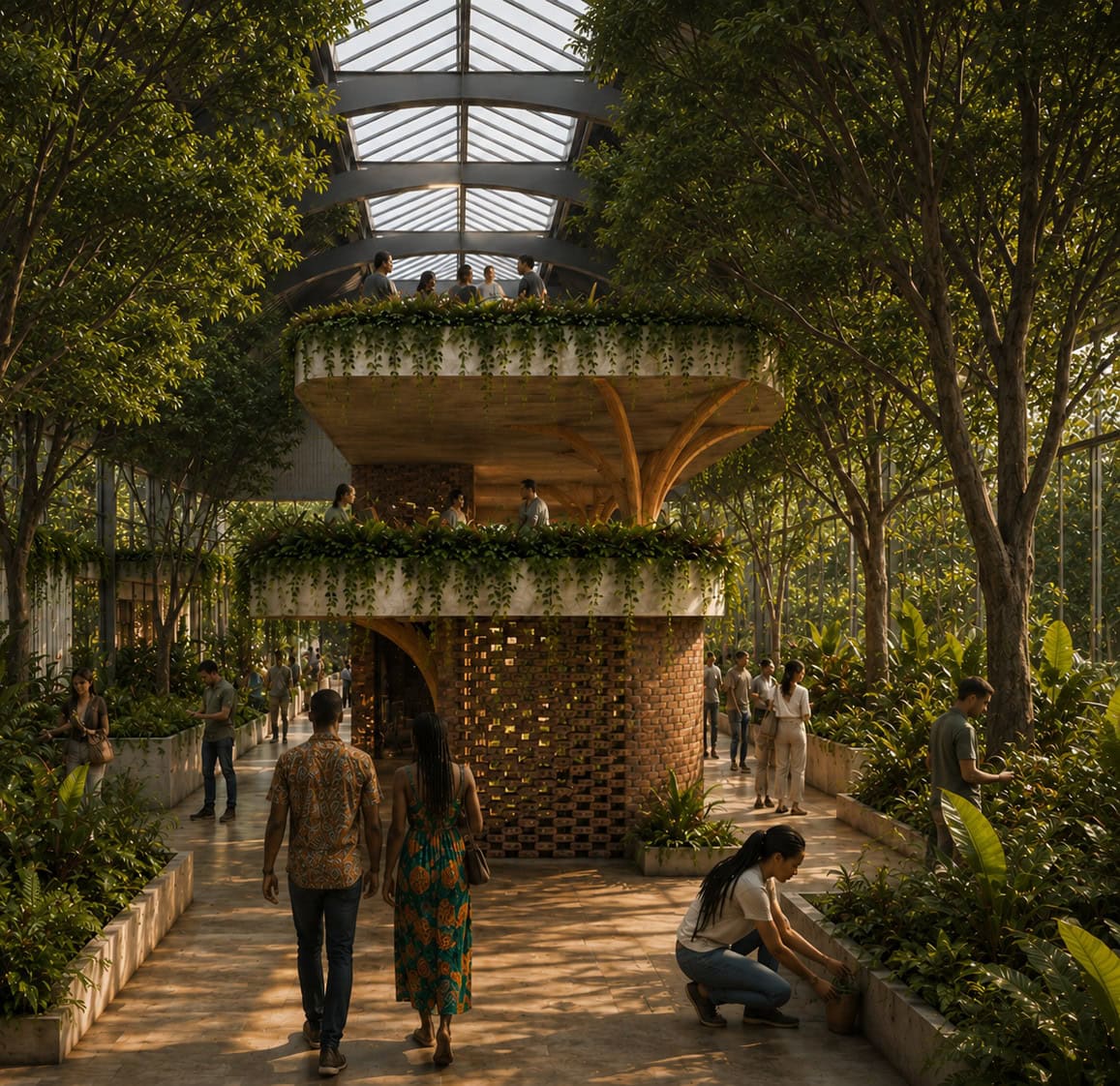
The most compelling architectural move is the transformation of the former first class swimming pool into an indoor garden and communal setting. Instead of filling the void with conventional floorplates, Shetty uses the height and memory of the original volume as an asset. That is the right instinct in a listed structure of this kind. The character of the pool hall lies in its sectional drama, its top light, and its clear public identity. Preserving that spatial reading allows the new programme to sit within the historic shell without flattening it.
This approach also helps the scheme avoid one of the common problems in heritage reuse, where the listed envelope is retained but the interior logic is stripped out. Here, the social function of the old baths is translated into a new kind of shared interior. The project still revolves around gathering, health, and public use, but through food production and exchange rather than washing and recreation.
The greenhouse insertions appear to be handled as contemporary additions rather than mimicry. That distinction is important. In listed work, clarity tends to be more convincing than imitation. By keeping new structures lightweight and legible against the retained masonry and historic fabric, Shetty allows the building’s chronology to remain readable. Principal facades, the playtower, and key internal elements are conserved, while the additions signal a change in use and period.
Technical thinking beyond the thesis image
What lifts the project beyond a strong visual concept is the amount of technical and environmental thinking behind it. Shetty developed structural studies, construction details, and environmental systems as part of the thesis, which gives the proposal more credibility as architecture rather than pure speculation. That matters, particularly in a retrofit project where the hard work often sits in servicing, moisture control, structural adaptation, and compliance constraints.
The environmental strategy is sensibly integrated with the brief. Rainwater harvesting supports the productive programme. Natural ventilation reduces operational demand and suits the large existing volume. Biodiversity measures and productive green infrastructure extend the building’s role beyond its walls. Low carbon material selection is also relevant here, not as a separate sustainability checklist item, but as part of a wider argument for retaining embodied carbon through reuse.
Vertical farming can sometimes read as a fashionable add on, especially in student projects. In this case it is tied to a coherent civic model. Produce is grown on site and redistributed through the kitchen, café, and market, while workshops and training create routes into participation and employment. That link between production and public access is what makes the scheme convincing. It is not a private technical system hidden behind an educational narrative. It is meant to be seen, used, and understood.
Why this matters to practices now
There is a clear relevance here for UK practices working across retrofit, community projects, housing, education, and public sector work. The industry is under pressure to reuse existing buildings more intelligently, show measurable social value, and address environmental performance without defaulting to demolition and rebuild. The Living Wells is useful because it brings those concerns together in one proposal and tests them against a real building with heritage constraints.
It also reflects well on Shetty’s readiness for practice. He already has more than two years of experience across residential work, technical drawing production, planning, BIM workflows, and multidisciplinary coordination through RIBA Stages 0 to 3. That background shows in the project’s level of resolution. For hiring directors looking for a Part 2 Architectural Assistant with a serious interest in adaptive reuse, sustainability, and technically informed design, this is the kind of academic work worth paying attention to.
To connect with Yash Shetty, visit his LinkedIn to view his latest work and professional experience, or contact him directly at shettyashraj@gmail.com.
If you are an architecture student, Part 1, Part 2, or young professional and would like your work featured by Architecture Social, submit your project and tell us what you are working on.
What this project shows
The Living Wells is useful because it shows Yash Shetty’s ability to connect a clear design idea with context, users and delivery constraints. It connects adaptive reuse, food production, public learning and social infrastructure inside a listed Lewisham building.
For employers reviewing student and graduate portfolios, the lesson is simple. Look past a single hero image and ask how clearly the candidate explains the brief, the site, the decisions and the technical consequences of the proposal.


Add a comment