

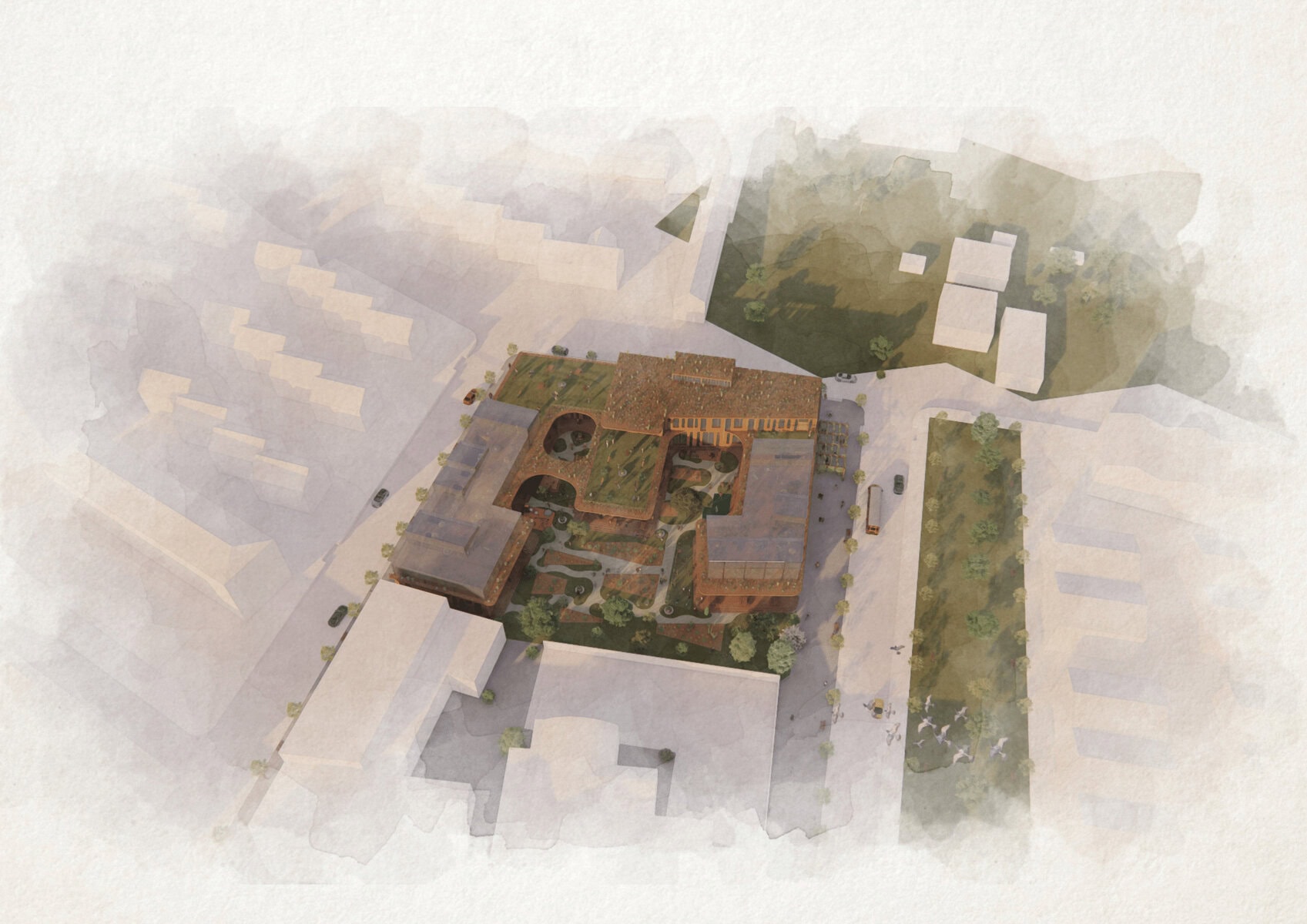
Nourishing Roots by Elena Warnakulasuriya is an adaptive reuse architecture project for the Grade II listed Orangery in Wakefield.
The project is useful because it does not treat heritage as something to freeze. It asks how an existing building can support food, learning, community life and urban growing.
Project overview
Elena is a Part I Architecture graduate from the University of Sheffield with an interest in people-centred architecture and graphic design. Her portfolio context includes retrofit schemes and polyvalent housing developments.
Nourishing Roots reimagines the Orangery as a community hub where food becomes a link between heritage, education, sustainability and local participation.
How the retrofit idea works
- The Grade II listed building gives the project an existing heritage story.
- The roof garden adds urban growing and outdoor learning.
- Food workshops create a reason for people to gather and return.
- The proposal links preservation with active use.
- The project frames sustainability through community behaviour, not only materials.
Why food strengthens the architecture
Food gives the project a clear social purpose. It supports education, workshops, local exchange and everyday community use, which makes the adaptive reuse architecture argument more tangible.
Showcase an adaptive reuse project
Architecture Social can feature retrofit and adaptive reuse work where the existing building, new use and community value are clearly connected.
- Explain what the existing building already offers.
- Show what changes and why.
- Connect the new programme to real users.
- Make heritage, sustainability and community value work together.
Architecture Social view
Stephen’s recruiter view is that retrofit work reads best when the candidate can explain the trade-off. What is protected, what is adapted, and how does the new use make the building matter again?
Next step
Explore more student projects, browse Part I Architectural Assistant jobs, or submit an adaptive reuse project.
If this project has made you rethink your own portfolio or next move, browse current architecture jobs or contact Architecture Social for a recruiter’s view.


Add a comment