
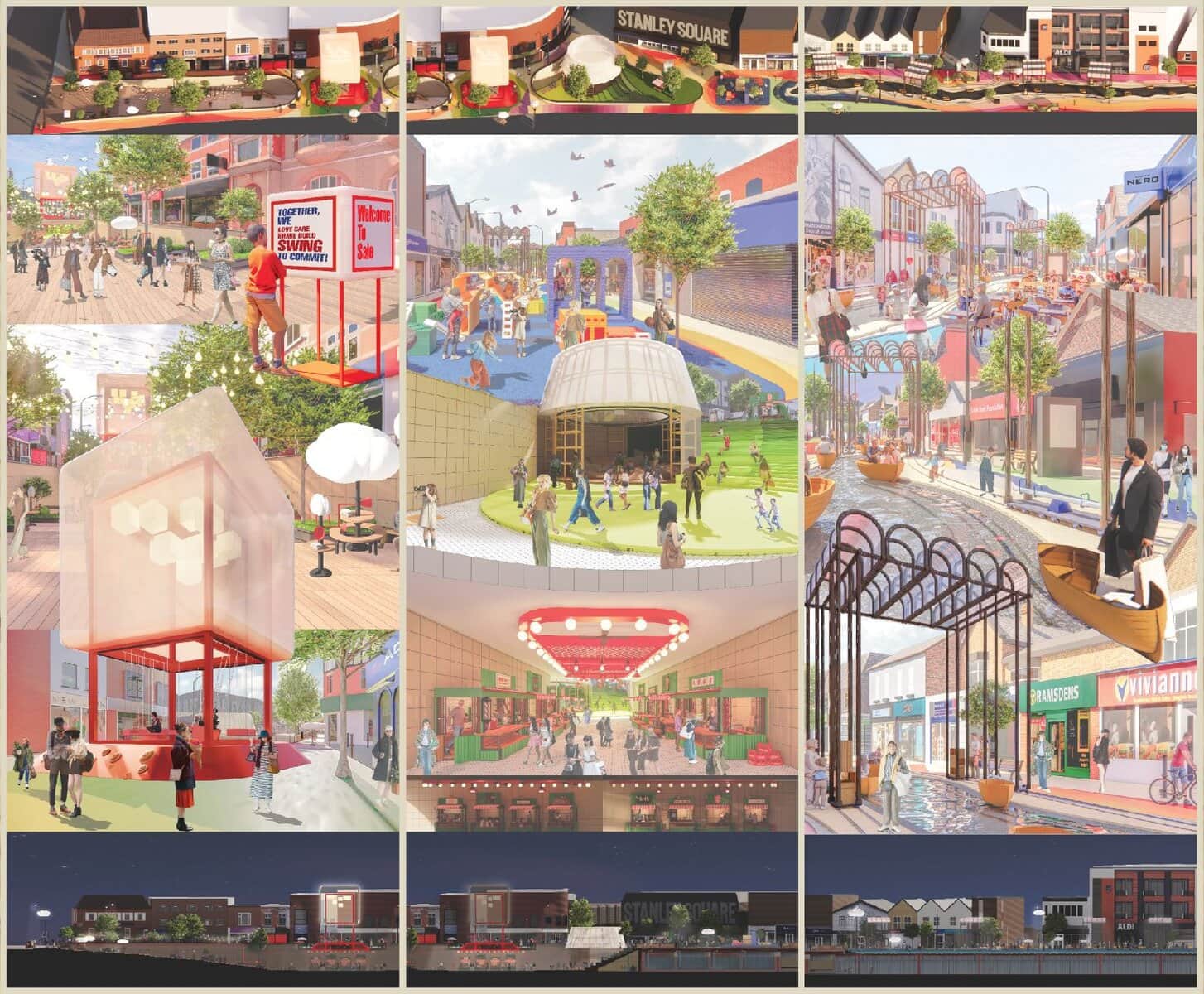
Our Common Backyard by Charlize Kam is a community architecture project about Sale’s School Road in Greater Manchester and how everyday public space can help people belong.
The project responds to the arrival of Hong Kong families and the small moments where neighbours meet, hesitate, talk, play or pass each other. It treats the street as a shared backyard rather than a leftover corridor.
Project gallery
The gallery shows the project’s street-based interventions, using small public-realm moves to support conversation, play, shelter and care.

Project overview
Charlize completed her Master of Architecture at Manchester School of Architecture. The original profile also notes four years of architectural experience in Hong Kong across residential, commercial and urban sectors.
That cross-cultural experience matters to the project. Hong Kong’s dense public life and Greater Manchester’s local streets are not treated as opposites. The design asks how a place can make room for different habits, languages and routines without forcing them into one neat identity.
What the project is testing
- How a street can become a shared social space for long-standing residents and new arrivals.
- How small interventions can make public life feel warmer without over-designing it.
- How cultural references can sit lightly inside furniture, planting, shelter and paving.
- How rain gardens and permeable surfaces can turn climate response into a visible community lesson.
Why the scale is important
The strength of the project is that it does not need a grand civic building to make its point. Benches, thresholds, gardens, shop edges and play areas become the architecture of belonging.
For a student portfolio, that is useful. It shows that Charlize can read a social condition and translate it into spatial detail, not just make a large urban gesture.
Showcase a community architecture project
Architecture Social can feature student work that deals with migration, public realm, local streets, neighbourhood care or shared civic life.
- Explain the community and the street condition clearly.
- Show the drawings or models that prove the public-life idea.
- Name the small design moves, not just the big ambition.
- Make the project useful for other students and practices to learn from.
Connect with Charlize Kam
Architecture Social view
Stephen’s recruiter view is that projects about belonging need evidence. This one is strongest when the reader can see exactly how a bench, garden, route or threshold changes the social behaviour of the street.
Next step
Explore more Architecture Social projects, read the portfolio guide, or submit your own project.
If this project has made you rethink your own portfolio or next move, browse current architecture jobs or contact Architecture Social for a recruiter’s view.



Add a comment