

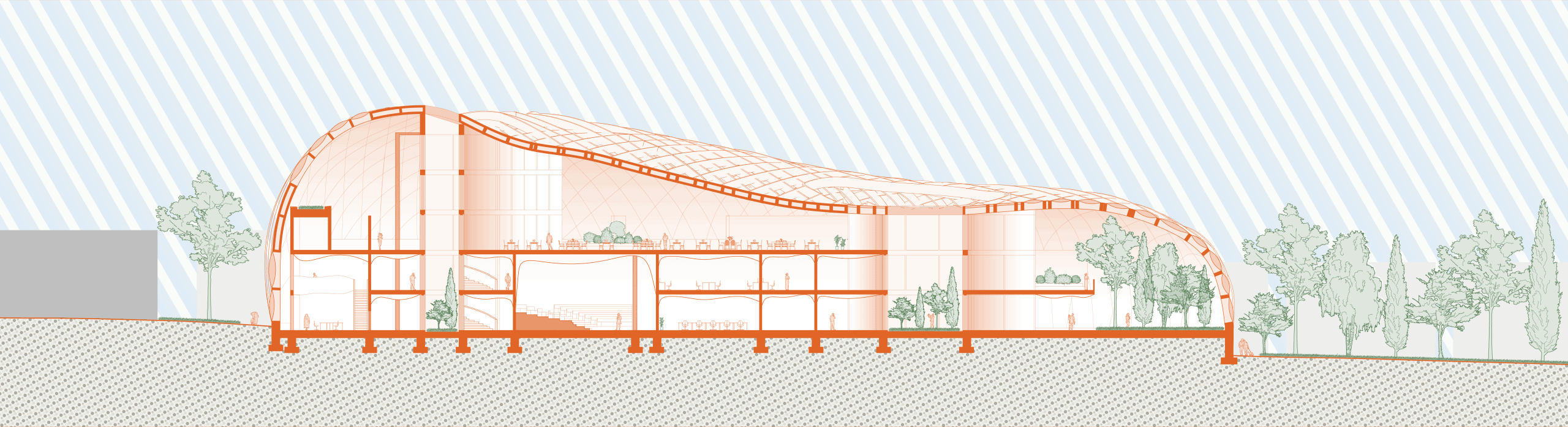
Shadath Chowdhry’s project proposes a masterplan for a new town of Shrewsbury, drawing on the spatial qualities of the old town while testing a more collective way of living.
The project is useful because it treats masterplanning as a social question. It asks how shared spaces can support bonding across different classes, generations and backgrounds while also responding to climate change.

The masterplan idea
Instead of presenting the new town as a blank extension, the proposal looks at what can be learned from the existing urban fabric. The older town becomes a reference for scale, routes, shared spaces and civic character.
- Collective ownership is used as a social and spatial theme.
- Shared spaces are designed to support everyday interaction.
- The masterplan responds to climate pressure rather than treating sustainability as an afterthought.
- The project connects urban form with community life.
Why the project needs clarity
Urban projects can become hard to read when they stay too abstract. A strong masterplan page should show the site logic, movement, public space hierarchy and social purpose in plain language.
View Shadath Chowdhry’s portfolio source
Shadath also shared an external portfolio route for readers who want to see more of the work and background.
Portfolio lesson
For masterplanning work, show the strategic idea first, then the evidence. Practices need to see how the plan responds to people, place, climate and future use.
Show the urban logic clearly
If you submit a masterplan, make the reader understand the site, the public-space idea and the social purpose quickly.
- Lead with the place and the urban problem.
- Show how movement, public space and ownership connect.
- Use images that explain scale and townscape.
- Keep the candidate biography short and let the project lead.
Next step
Submit your student, graduate or practice project to Architecture Social Showcase if it has a clear story and useful visual evidence.




Add a comment