
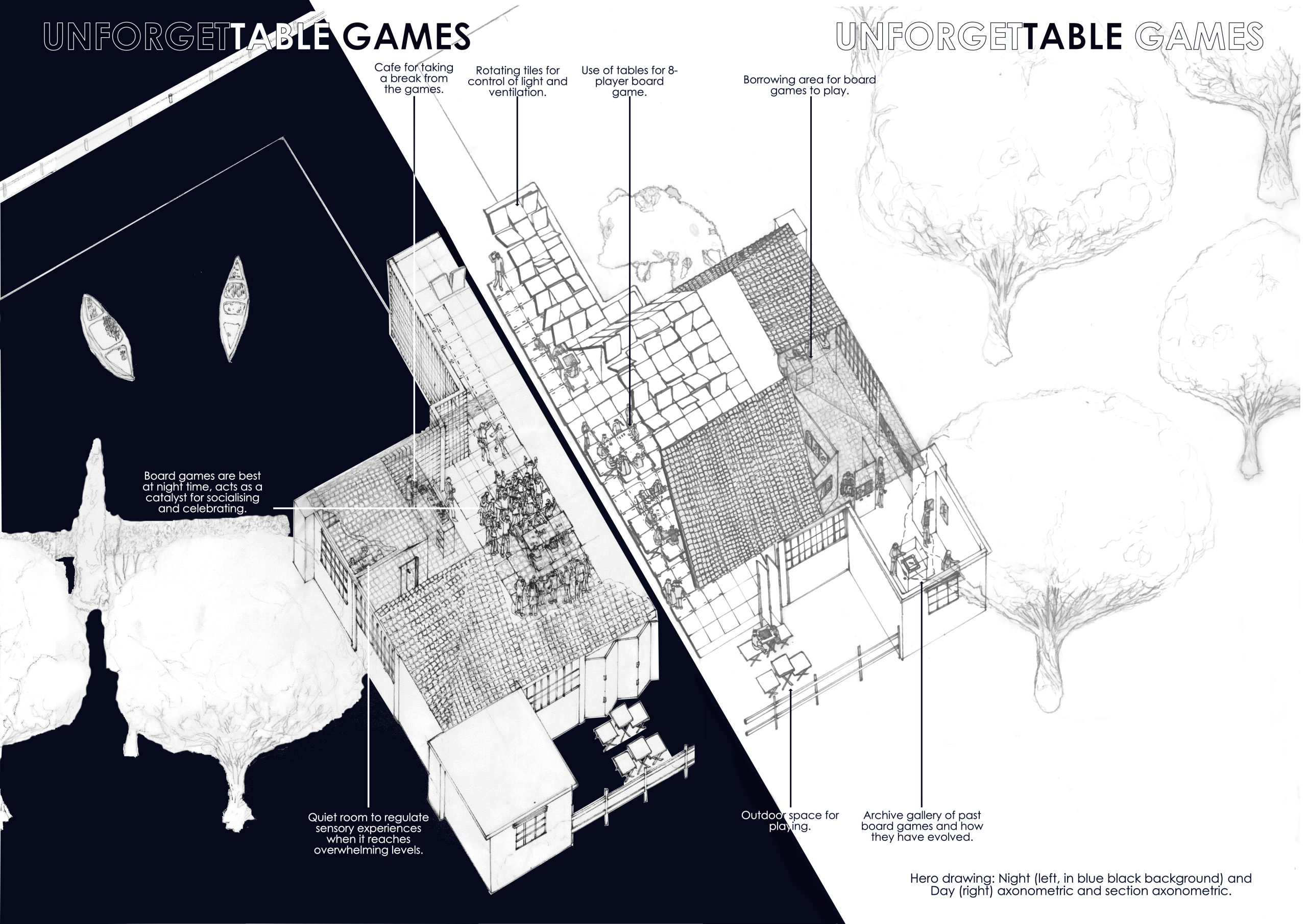
Unforgettable Games by Andrew Maghari turns a neglected Nottingham Boathouse into a community architecture project about play, social connection and flexible use.
The useful idea is not simply that people like board games. It is that a clear spatial system, built around modular tables, can let different groups use the same building in different ways across the day and night.

Project overview
Andrew developed UnforgetTABLE Games while studying architecture at the University of Nottingham. The original profile notes that he received the Tutor’s Choice Award for his IDP 3 project and has also supported 16 to 18 year olds exploring architecture through InvestIN.
The site is the Boathouse in University Park, a waterside structure that had become quieter after commercial boating activity changed the lake’s use. Andrew treats that silence as a chance to give the building a new social purpose.
What the table system does
- Creates different heights and arrangements for different games.
- Lets small groups and larger events use the same interior.
- Makes accessibility and comfort part of the design logic.
- Gives the project a repeatable rule, rather than a one-off theme.
Why play is a serious brief
A board-game lounge can sound light, but the architectural questions are solid: how people gather, how furniture controls behaviour, how a building works outside normal hours and how a student space can also welcome local residents.
That gives the project a useful tension. It is playful in tone, but it still needs planning, access, lighting, storage, circulation and a clear operational idea.
Showcase a playful community project
Architecture Social can feature student work where play, leisure, public life or community use drives the design idea.
- Explain the user groups and how they share the space.
- Show the system that makes the project flexible.
- Include drawings or models that prove the atmosphere.
- Make the social idea clear enough for other students to learn from.
Architecture Social view
Stephen’s recruiter view is that playful projects become stronger when they show judgement. If the reader can understand the rules behind the fun, the project feels thoughtful rather than gimmicky.
Next step
Explore more student and practice projects, read the portfolio guide, or submit your own project.
If this project has made you rethink your own portfolio or next move, browse current architecture jobs or contact Architecture Social for a recruiter’s view.


Add a comment