Description
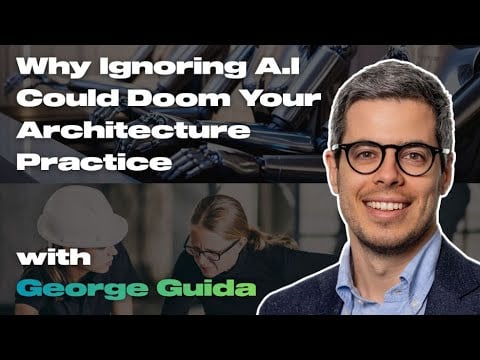
This CPD lesson is drawn from the Architecture Social Podcast conversation with George Guida, architect, educator and founder of xFigura, on AI in architecture. The episode runs for roughly 48 minutes and traces George's path from studying architecture in the UK to building an AI platform used by practices, while exploring what generative tools mean for the way architects work.
Who this is for
Architects, architectural technologists, Part 1 and Part 2 assistants, students and educators who want a grounded view of how generative AI is being used in practice. It is equally useful for anyone weighing whether and how to adopt AI tools, and for practice owners thinking about workflow, hiring and the future shape of the profession.
Learning outcomes
After working through this lesson, you will be able to:
- Describe how generative AI is being applied across the concept-design and ideation stages of an architectural project.
- Distinguish between the main categories of generative model (text, image, video and 3D) and identify where each is useful.
- Explain why model selection matters and how different training data shapes the outputs you get.
- Discuss the limits of AI in architecture, including the black-box problem, hallucinations and accountability.
- Draw practical lessons for building and launching an AI product, from UX to shipping imperfect software and managing a remote team.
- Reflect on how AI may reshape architectural education and the value architects offer clients.
From Oxford Brookes to Harvard: a computational path
George trained as an architect at Oxford Brookes University and the Architectural Association, then spent several years at Foster + Partners in London, where performance-based design put environmental testing and "designing through numbers" at the heart of the process. That experience sparked a deeper interest in computational design and robotics, and led him to the Harvard Graduate School of Design, where he worked on applied machine learning, training and classifying architectural datasets, and generating synthetic data to build new 3D models.
Why xFigura exists: taming the AI noise
George describes a market full of noise: a constant stream of new tools, fast-changing models and, in his view, often poor user experience. xFigura grew out of consulting work with architecture firms wrestling with exactly these pain points: which model is best, how to manage subscriptions, and how to map a coherent creative process across many platforms. The aim was to piece all of it together into one place.
Inside the platform: an infinite canvas for architects
George frames xFigura as "a Miro for architects": an infinite, collaborative canvas powered by AI and aimed squarely at concept design and ideation, with the architect kept in the driving seat. Designers can trace their history from an input such as a Rhino screenshot or a hand sketch, generate high-resolution images, combine styles, and move into video and 3D. The platform brings a curated set of leading models together, and includes a Speckle integration so users can connect Rhino, Revit or SketchUp and generate views from an existing model. George notes that image-to-3D uses a multi-view process, building from multiple generated views.
Choosing the right model for the job
A recurring theme is that there is no single best model. Each model is strong or weak for particular tasks, and every company trains on different data, so outputs carry an underlying subjectivity that designers can influence and should be aware of. George highlights the value of open-source models, which let users get under the hood, train their own models and avoid being locked into a single proprietary tool. Being first to market, he argues, counts for a great deal in the AI race.
Building an AI startup: shipping imperfect, working remotely
xFigura launched its MVP in late 2025, after months spent defining the vision and finding a market amid the AI noise. George is candid about a challenge familiar to many software founders: deciding when to ship. The launch was not perfect and carried the usual bugs, but getting it out in an imperfect state was the important step. On team-building, he favours a hybrid model, and is open about the difficulty of growing an online culture across time zones.
AI and architectural education
George teaches AI and architecture, including at the University of Pennsylvania, and argues that all students should have some exposure to AI, including its ethics, bias and data questions. He points to the World Economic Forum's emphasis on flexibility, adaptability and resilience, and to the importance of preserving critical thinking rather than depending on the tools. He is interested in the flipped-classroom model, using in-person time for critical thinking, teamwork and collaboration while moving more passive learning, sometimes AI-augmented, outside the classroom.
Augmentation, not replacement
George does not expect AI to replace architects, but believes that early adopters who engage with the tools will be more competitive and more secure over the medium and long term. He and Stephen discuss the idea that client-facing, interpersonal work is hardest to replace, while routine, repetitive tasks are most exposed. The framing throughout is AI as a capable collaborator or "apprentice" rather than a substitute for professional judgement.
Accountability, the black box and standard of care
A serious thread runs through the conversation: architects carry a duty of care for public safety and welfare, and much generative AI is effectively a black box, where the path to a decision cannot be traced. That raises hard questions about hallucinations and accountability, for example around code compliance or signing off a drawing set. George notes that explainability is an active area of research, but that the profession is not there yet, which is one reason architects will remain essential.
The future of the profession
George is broadly optimistic but flags fragmentation, especially in software, and argues that professional bodies such as the RIBA, ARB, NCARB and AIA should take a clearer stance on where the profession is heading in light of AI. He sits on the RIBA's expert advisory group on AI and references a recent RIBA survey showing a marked year-on-year rise in adoption. His call is for architects to expand and diversify their scope, to adopt a more entrepreneurial, startup mindset, and to make sure they sit in the driving seat of the software shaping their field.
Key terms
- Generative AI: models that create new content (text, images, video or 3D) from a prompt or input, rather than only analysing existing data.
- Infinite canvas: an open, zoomable collaborative workspace where multiple inputs, outputs and workflows can sit together.
- Speckle: an open data platform for connecting design tools such as Rhino, Revit and SketchUp and exchanging model data.
- Multi-view 3D generation: building a 3D model from several generated views (for example front, side and back) of an object.
- Performance-based design: a design approach driven by measurable environmental and technical performance alongside aesthetics.
- Black box / explainability: the difficulty of tracing how an AI system reaches an output, and the research effort to make that reasoning transparent.
- Standard of care: the professional duty an architect owes for public safety and welfare.
- Flipped classroom: a teaching model that moves passive learning outside class and uses contact time for critical, collaborative work.
Reflective prompts for your CPD record
- Where in your current workflow could a generative AI tool genuinely save time at concept stage, and where would it introduce risk you would need to manage?
- How would you assure accountability and standard of care if AI were involved in any part of your design or compliance process?
- What is one skill, technical or interpersonal, you could develop now to stay competitive as AI adoption rises in practice?
About the guest
George Guida is an architect by training, an educator, and the founder of xFigura, an AI platform for architects. He studied at Oxford Brookes University and the Architectural Association, worked at Foster + Partners in London, and continued his education at the Harvard Graduate School of Design. He teaches AI and architecture, including at the University of Pennsylvania, and sits on the RIBA's expert advisory group on AI. Find out more at xfigura.ai.
Audio
Video
Industry
Topics
Company

People