
Description
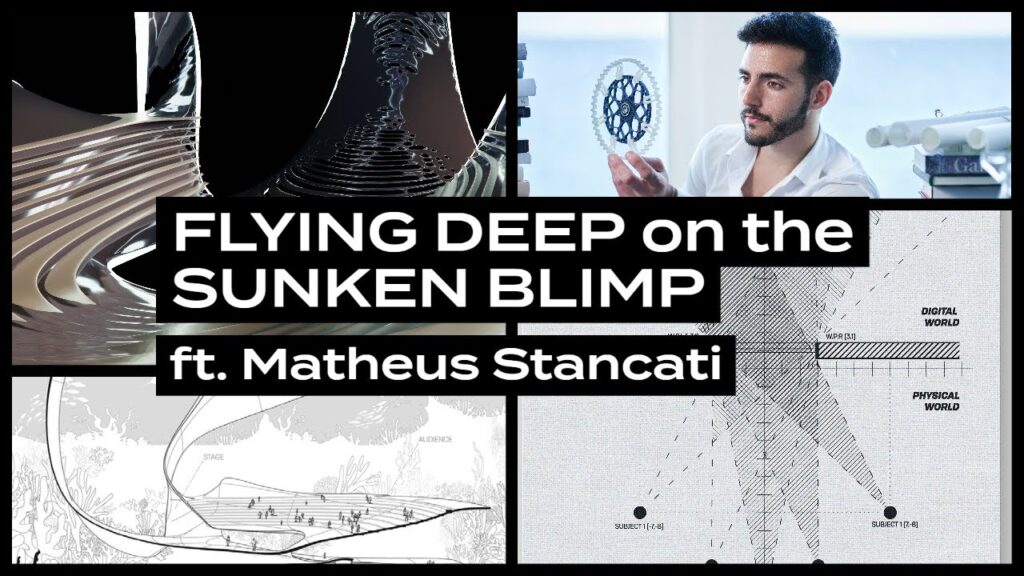
In this Architecture Social CPD, Stephen Drew speaks with Matheus Stancati, co-founder of Sunken Blimp, a self-described vessel for design exploration that works across architecture, computational design, digital fabrication and extended reality. The conversation ranges from carbon-negative fabrication to virtual community building, and asks what happens when architects treat curiosity, rather than a fixed brief, as the starting point. Running time is roughly 45 minutes.
Who this is for
Architects, architectural assistants, computational and 3D designers, students, and anyone curious about how digital fabrication, extended reality and the metaverse are widening what architectural practice can be.
Learning outcomes
By the end of this session you will be able to:
- Explain how an interdisciplinary studio converges design, science and technology rather than working to a single house style.
- Describe how digital fabrication and bio-based materials can be used to prototype carbon-negative structures.
- Recognise how physical and digital environments can be bridged through digital twins and personalised space.
- Weigh the accessibility trade-offs between browser-based virtual platforms and VR headsets.
- Understand how community, blockchain provenance and open contests can shape a design practice.
- Assess emerging career routes for architects working across phygital and metaverse design.
A vessel for design exploration
Matheus describes Sunken Blimp not as a conventional studio but as a vessel for exploration, set up to question how things are normally done and to merge fields that rarely meet. Trained as an architect and drawn into robotics, parametric construction and research at the intersection of architecture, neuroscience and artificial intelligence, he co-founded the studio with a clinical neurologist so that two very different disciplines could collaborate on work that goes beyond either field alone.
Carbon-negative fabrication
One of the studio's first fronts was agriculture. Responding to land scarcity in Southeast Asia, the team designed a more efficient hydroponic growing system built from a bamboo structure and 3D-printed bioplastics. Because the materials draw carbon out of the atmosphere, the prototype is intended to be carbon negative, and it was developed in collaboration with hydroponics specialists and engineers to test and optimise the design.
The Sanctuary and physical prototyping
Sunken Blimp planned to acquire physical land, called the Sanctuary, parcelled into sections where new ideas could be prototyped and built: sustainable farming, affordable and carbon-negative housing, and other phygital construction experiments. The intent was to pair digital design with real fabrication rather than keeping the work purely speculative.
Roomship and personalised space
Roomship is the studio's workflow for scanning a physical room and processing it as a virtual asset, a digital twin that lets people dock their space, connect it to others and change the environment they see through the window. Matheus frames this through the idea that information about who we are already flows everywhere, yet the physical spaces we occupy are rarely connected to it. Bridging that gap, so that spaces can respond to the people in them, is a large part of what interests the studio.
Accessibility over spectacle
The team favours accessible platforms such as Spatial, which open from a single link on a phone or laptop with no headset required. Matheus is enthusiastic about virtual reality, but is clear that a technology is only a tool, and that keeping the barrier to entry low matters more than raw spectacle if the aim is to bring a wide community in.
New rules for virtual design
Designing for virtual space swaps one set of constraints for another. Budget and building regulations fall away, but the polygon count becomes the new limit: push the geometry too far and a space will not load, or will lag and spoil the experience. Matheus points out that game designers have worked within these limits for years, which is exactly why he sees collaboration between architects and game designers as essential rather than competitive.
Architects and the shaping of the void
Asked what architects specifically bring to virtual worlds, Matheus returns to fundamentals: architecture, at its simplest, is the art of shaping the void so that people feel a certain way in a constructed space. That training in choreographing experience carries directly into spatial design in the metaverse, where the discipline is less about objects and more about how people move through and use an environment.
Community, contests and provenance
Community sits at the centre of the model. Rather than simply sharing a link, the studio scattered several hundred QR-coded ping-pong balls across US cities, on the theory that anyone curious enough to scan one would be the kind of person worth having in the community. Members gather on Discord and can submit projects to open contests, with winning ideas funded for prototyping at the Sanctuary, and the studio uses NFTs to grant access and record provenance for digital assets.
Distributed teams and careers
Remote working, Matheus argues, lets a studio draw talent from anywhere, so a team can hold different cultures, languages and ways of thinking that make the work richer. On careers, he and Stephen compare metaverse roles today to computational design a decade ago: niche at first, then steadily absorbed into mainstream practice as tools mature and commercial demand grows.
Key terms
- Digital fabrication: making physical components directly from digital designs, for example with robotic arms or 3D printers.
- Phygital: design that deliberately links physical and digital environments.
- Digital twin / Roomship: a virtual copy of a physical space created by 3D scanning.
- Poly count: the amount of geometry in a virtual model, which acts as a practical budget for performance.
- Spatial: a browser and mobile-friendly platform for hosting virtual spaces and events.
- NFT provenance: using the blockchain to record the creator and ownership of a digital asset.
Reflective prompts for your CPD record
- Where could digital fabrication or bio-based materials change how you prototype in your own work?
- How would you balance accessibility against visual fidelity for the audience you are designing for?
- What skills would you need to develop to work confidently across phygital or metaverse design?
About the guest
Matheus Stancati is co-founder of Sunken Blimp, an interdisciplinary studio that describes itself as a vessel for design exploration across architecture, computational design, digital fabrication and extended reality. You can find out more at sunkenblimp.com.
Audio
Video
Industry
Topics
Company

People


