Logo of Architecture Social with bold, white, capitalized text on a dark background.
    • Forum
    • Directory
      • Browse All
      • Jobs
      • Companies
      • Events
      • Projects
      • People
      • Universities
      • Upload to Directory
    • Jobs
      • Browse All
      • Architecture
        • Architectural Apprentice
        • Architectural Assistant – Part I
        • Architectural Assistant – Part II
        • Architect
        • Project Architect
        • Senior Architect
        • Architectural Technician
        • Architectural Technologist
        • Architectural Visualiser
      • BIM & Computational Design
        • BIM Coordinator
        • BIM Consultant
        • BIM Director
        • BIM Manager
        • BIM Modeller
        • BIM Technician
        • Computational Design
        • Digital Information Manager
      • Business Support
        • Bid Coordination
        • Business Development
        • Document Controller
        • Executive Assistant
        • Facilities Manager
        • Finance
        • Graphic Designer
        • Human Resources
        • Marketing
        • Operation Manager & Director
        • Practice Manager
        • Project Administrator
        • Receptionist
        • Studio Coordinator
        • Studio Manager
      • CAD & IT
        • CAD Manager
        • Head of IT
        • IT Technician
        • IT Manager
      • Development & Real Estate
        • Design Coordinator
        • Design Manager
        • Development Management
        • Project Manager
        • Technical Coordinator
      • Interior Design
        • Graduate Interior Designer
        • Interior Architect
        • Interior Designer
        • Midweight Interior Designer
        • Senior Interior Architect
        • Senior Interior Designer
      • Landscape Design
        • Junior Landscape Architect
        • Landscape Architect
        • Senior Landscape Architect
        • Landscape Designer
        • Landscape Planner
      • Recruitment Consultant
        • Join Our Team
      • Strategic Appointments
        • Associate
        • Associate Director
        • Director
      • Urban Design
        • Junior Urban Designer
        • Urban Designer
        • Senior Urban Designer
      • Upload your CV + Portfolio
    • Resources
      • Browse All
      • Career Guides
      • Benefits Guides
        • Career Development
        • Financial
        • Health and Wellbeing
        • Work-Life Balance
      • Salary Guides
        • Architecture
          • Architectural Apprentice
          • Architectural Assistant Part I
          • Architectural Assistant Part II
          • Architect
          • Project Architect
          • Senior Architect
          • Architectural Technician
          • Architectural Technologist
          • Architectural Visualiser
        • BIM & Computational Design
          • BIM Coordinator
          • BIM Consultant
          • BIM Director & Head of BIM
          • BIM Modeller
          • BIM Manager
          • BIM Technician
          • Computational Design
        • Business Support
          • Bid Coordination
          • Business Development
          • Document Controller
          • Executive Assistant
          • Facilities Management
          • Finance
          • Marketing
          • Operations Manager
          • Practice Manager
          • Project Administrator
          • Receptionist
          • Studio Coordinator
          • Studio Manager
        • CAD & IT
          • CAD Manager
          • Head of IT
          • IT Manager
          • IT Technician
        • Development and Real Estate
          • Asset Manager
          • Design Manager
        • Interior Design
          • Graduate Interior Designer
          • Junior Interior Designer
          • Interior Designer
          • Midweight Interior Designer
          • Senior Interior Designer
        • Landscape Design
          • Junior Landscape Architect
          • Landscape Architect
          • Senior Landscape Architect
        • Strategic Appointments
          • Associate
          • Associate Director
          • Director
        • Urban Design
          • Urban Designer
          • Senior Urban Designer
          • Junior Urban Designer
      • Newsletter
      • Podcast
        • Audio
        • Livestreams
        • Reels
        • Videos
      • Tools
        • All Tools
        • Notice Period Calculator
        • Pay Rise Calculator
        • Unpaid Overtime Calculator
    • Our Services
      • Browse All
      • Advertising
      • Coaching
        • Career Coaching
        • Business Coaching
      • CV + Portfolio
        • Review and Feedback Sessions
        • Publish via our Social Media to Employers
      • Marketing
        • For Designers
        • For Practices & Studios
      • Recruitment
        • I’m looking for a job
        • I’m looking to Hire
          • Traditional Recruitment Service
          • In-House Recruitment Service
        • Recruitment Referral Scheme
    • Contact Us
      • Meet our Team
        • Join Our Team
      • Get in Touch
    Upload
    Sign in or Register
    0
    Upload
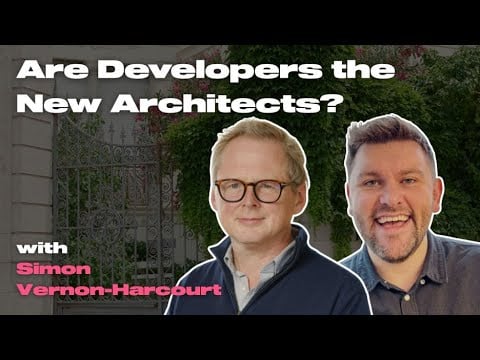
    Simon Vernon-Harcourt, Design Director at City and Country, on the Architecture Social podcast

    From Architect to Developer: Converting Historic Buildings into Homes

    • Browse for more CPDs
    • Overview
    • Course
    • Company
    • Discuss
    • prev
    • next
    • Bookmark
    • Share
    • prev
    • next

    Description

    A CPD lesson drawn from the Architecture Social podcast with Simon Vernon-Harcourt, Design Director at City & Country, recorded in April 2025. Running time roughly 39 minutes.

    Who this is for

    Architects, Part 1 and Part 2 assistants, and architectural students who are curious about the developer side of the industry, and anyone interested in heritage conversion, listed building work and residential development. It is also useful for practising architects who want to understand how a developer thinks about sites, value and design.

    Learning outcomes

    1. You will be able to describe how an architect's role differs from a design-led role inside a developer.
    2. You will be able to explain why conversion projects carry more cost and risk than equivalent new build.
    3. You will be able to outline how a heritage-focused developer finds, appraises and secures unusual sites.
    4. You will be able to assess where technology and AI add value to conversion work and where hands-on judgement still matters.
    5. You will be able to identify what makes an architect or graduate stand out when working with, or applying to, a developer.
    6. You will be able to reflect on the relationship between housing policy, land supply and opportunities for small and medium-sized developers.

    From architect to developer

    Simon trained as an architect, studying at Portsmouth University after a BTEC, and worked in practice before moving client-side. He describes the move to a developer as the scariest decision of his career, one he turned down twice before accepting. The lesson he draws is that the leap felt risky precisely because architectural education frames practice as the only legitimate path, when in reality design talent is valuable across the wider built-environment industry.

    What changes when you sit on the client side

    As a developer you stop waiting for a brief and start looking for sites, asking what a building could become. Design becomes one part of a bigger picture that also includes commercial appraisal, construction, sales and programme. Simon notes that a developer might run only two or three large projects a year, compared with eight or nine at varying stages in a practice, so each scheme is lived with in more depth. He frames it as a team sport, where designers, the commercial team and the sales team feed into one another.

    Inside City & Country's conversion projects

    City & Country grew from pure conversion work, taking buildings such as former Victorian institutions, hospitals, a tobacco factory in Bristol and a former school in Edinburgh, and turning them into apartments. Over recent years the company has added new-build housing, but approaches it the same way: studying the history, the old plans and the existing fabric to find and enhance the character of a place. Conversions are bespoke by nature, with each apartment shaped by its existing features, views and orientation, rather than a repeated unit stacked floor on floor.

    The economics and risks of conversion

    Conversion is more expensive and riskier than new build because you cannot fully predict what you will find, from dry rot to failing structure. It needs reasonably strong sales values to stack up, which is why the company concentrates on locations with the values to support restoration. Some beautiful buildings simply do not work when restoration costs exceed achievable sales values. Contingency, commercial discipline and going in with eyes open are part of the job.

    Finding and securing unique sites

    Few developers want to tackle large historic buildings, so the market is relatively small and specialist. City & Country is often approached directly by agents selling commercial or institutional property, and maintains a working relationship with Historic England. Some deals take years to complete as wider conditions fall into place, while others move quickly. Early dialogue with local authority conservation officers can unlock more of a building than an existing outline consent allowed.

    Technology, AI and the craft of design

    For conversion, Simon finds that 3D technology makes less difference because the building already exists and can be walked, measured and even marked out on site. He still values sketching and spatial imagination, picturing himself living in each flat to test whether the layout works. On AI, he is optimistic rather than fearful: he expects it to take on more rule-based and repetitive tasks, such as routine layouts and coordination, while the creative spark, the new idea and the act of buying, building and selling remain human.

    Advice for aspiring architects

    Having visited many schools of architecture with his daughter, Simon observes that courses sit on a spectrum from creative to technical, and the industry needs both. His advice is to research widely, visit lots of universities and choose the school that fits your strengths. He places real weight on early work experience, even unpaid summer placements, because seeing inside a practice tells an employer that a candidate knows what they are letting themselves in for.

    How to work well with a developer

    From the client side, Simon values confidence, a clear point of view and evidence of how a practice is actually run and projects delivered, not just the design. When things do not work, it is often a question of fit rather than ability. For interviews and pitches, he encourages candidates and practices to be themselves, show their thinking step by step, bring strong examples, and demonstrate that they can collaborate and one day represent the practice to clients.

    Housing, planning and the wider outlook

    Simon is broadly optimistic about housing. He argues that releasing more land and pushing local authorities to deliver more homes could create opportunities for small and medium-sized developers to do something more creative than the volume housebuilders. He makes the case that housing, often overlooked by architects, is where people spend much of their lives, and that well-proportioned, characterful homes, whether modern or traditional, are worth fighting for.

    Key terms

    Conversion: reworking an existing building, often historic or listed, into a new use such as homes, rather than demolishing and building new.
    Enabling development: new build, often on the same site, that helps fund the restoration of a building that would not stack up financially on its own.
    Outline consent: an early-stage planning permission that establishes the principle of development, with details settled later.
    Conservation officer: a local authority specialist who advises on changes to historic and listed buildings.
    Historic England: the public body that advises on and helps protect England's historic environment.
    Values stacking up: shorthand for whether projected sales values cover the cost and risk of a scheme well enough to proceed.

    Reflective prompts for your CPD record

    1. How would your day-to-day work change if you moved from responding to briefs to actively sourcing and appraising sites?
    2. On a current or recent project, where could rule-based tasks be handed to technology, and where is human design judgement essential?
    3. What practical work experience or evidence could you build to stand out to a developer or design-led client?

    About the guest

    Simon Vernon-Harcourt is the Design Director at City & Country, a developer specialising in the restoration and conversion of historic and listed buildings into homes, alongside new-build housing across the UK. A qualified architect, he previously worked in architectural practice before moving to the developer side, and now leads the company's design work and collaborations with external architects.

    Audio

    Video

    Industry

    • Architecture

    Topics

    • Places, planning and communities
    • Design, construction and technology
    • Personal & Professional Development
    • Careers

    Company

    City & Country

    People

    Simon Vernon-Harcourt

    Engage in career growth through networking and coaching in a modern community platform.

    Join the Architecture Social Club

    A private and exclusive forum for Architecture & Design professionals and students.

    Backed by industry specialists, it’s where you can engage in meaningful conversation, make connections, showcase your work, gain expert insights, and tap into curated opportunities to advance your career or strengthen your studio.

    Register or Login Here

    Engage in career growth through networking and coaching in a modern community platform.

    Join the Architecture Social Club

    A private and exclusive forum for Architecture & Design professionals and students.

    Backed by industry specialists, it’s where you can engage in meaningful conversation, make connections, showcase your work, gain expert insights, and tap into curated opportunities to advance your career or strengthen your studio.

    Register or Login Here

    You May Also Be Interested In

    Understanding Your Worth in Architecture: A Guide to Navigating Salaries

    Architecture Social
    Architecture Social
    • Bookmark

    What do you do after an Architecture Interview?

    Architecture Social
    Architecture Social
    • Bookmark

    Mastering Communication in Architecture: Lessons from Industry Experts

    Architecture Social
    Architecture Social
    • Bookmark
    Click Here For Accessibility Options
    Update Your Privacy Preferences
    • Mission
    • Team
    • Join Us
    • Partnerships
    • Mission
    • Team
    • Join Us
    • Partnerships
    • Philanthropy
    • Submit
    • Blog
    • Philanthropy
    • Submit
    • Blog
    • Privacy
    • Recruitment
    • Website
    • Privacy
    • Recruitment
    • Website

    Architecture Social Limited © 2026

    1 Fore St Ave, Barbican, London EC2Y 9DT

    +44 (0)20 7770 9572

      • Facebook
      • X
      • WhatsApp
      • LinkedIn
      • Mail
      • Copy link
      • Share via...
      Cleantalk Pixel