Description
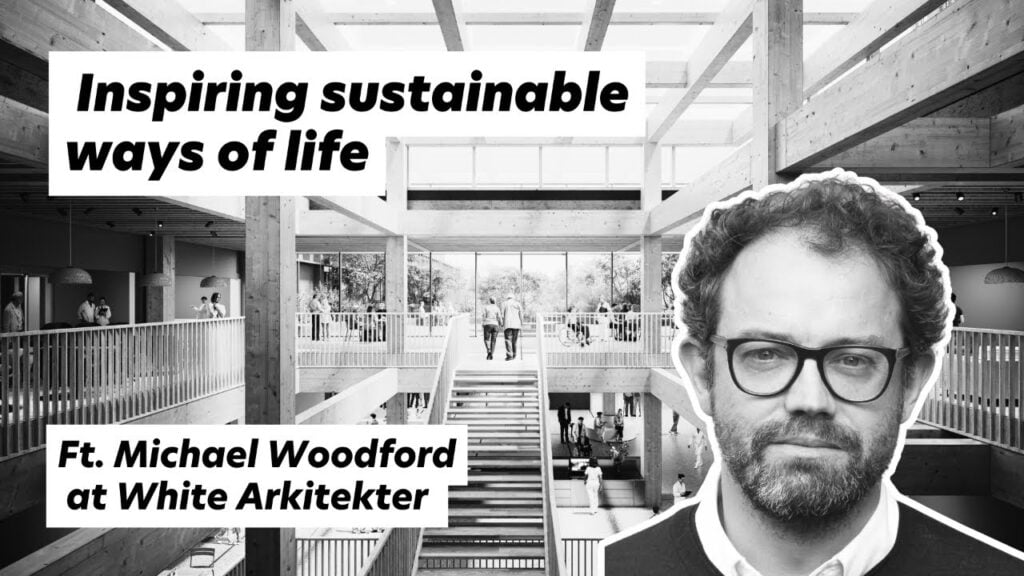
In this Architecture Social conversation (around 32 minutes), architect Michael Woodford, Partner and London studio lead at White Arkitekter, explores how a Swedish, sustainability-led practice approaches healthcare, housing and civic design, and what that means for architects who want to build greener, more international careers. The focus throughout is sustainable architecture as an everyday discipline rather than a slogan.
Who this is for
Part 1 and Part 2 architectural assistants, architects, students and career changers interested in sustainable design, timber construction, healthcare and social architecture, and anyone curious about working in a Scandinavian, employee-owned practice in the UK.
Learning outcomes
By the end of this session you will be able to:
- Describe how White Arkitekter runs an international, employee-owned studio model and what that means day to day.
- Explain how sustainability targets can be written into a practice's strategic plan and partner agreement.
- Recognise the role of timber construction and low-carbon design in contemporary healthcare and civic projects.
- Summarise how the Well-being of Future Generations (Wales) Act shapes the brief for public buildings.
- Identify what a studio leader looks for in a CV, covering letter and portfolio.
- Consider how circular economy thinking and material reuse can inform everyday practice.
A Swedish practice with an international outlook
White Arkitekter was founded in Gothenburg in 1951 and has grown to around 700 people across roughly 13 studios, with its largest office in Stockholm and further studios across Sweden, plus Oslo, Stuttgart and London. Michael has been with the practice for about six years and leads the London studio, which works on projects in the UK and further afield, including Canada and Nairobi. He studied and worked in the Netherlands and spent an Erasmus year in Copenhagen, and was drawn to White for its European outlook.
Sustainability written into the business
Sustainability is treated as core rather than optional. Michael explains that it is written into the partner agreement and the practice's strategic plan, with a commitment to reduce the carbon impact of its projects. Around 40 per cent of the practice's projects in the previous year used a timber bearing structure, reflecting how deeply low-carbon construction is embedded in the work.
Healthcare and the Well-being of Future Generations Act
Healthcare is a significant part of the practice. Michael discusses a cancer centre in Cardiff that carries a far-reaching sustainability brief drawn from the Well-being of Future Generations (Wales) Act, which asks public bodies to weigh the long-term impact of decisions on future generations. The brief emphasises low-carbon design, access to nature and nature-based solutions, alongside the benefits to patients. The London team is also working on Cambridge Children's Hospital.
Timber and low-energy design
Michael points to a fully timber office building the practice completed in Uppsala, Sweden, which achieved LEED Platinum and very low energy use. Sweden's timber tradition and abundant forests make timber construction a natural part of the practice's approach, and the team continues to promote timber even where UK regulations make it more complex.
Studio culture: flat, discursive, employee-owned
White Arkitekter has been employee-owned since it was set up, and everyone in the office can become a shareholder. Michael describes a flat, discursive culture where every voice can be heard, supported by collaboration across the practice's international offices. The studio runs talks in the Swedish tradition of Fika (coffee and cake), holds CPDs and events, and has a research fund that anyone can apply to. The team even used research time to calculate the embodied carbon of their own refurbished office.
How the studio is using AI
Michael sees AI as most useful for the mundane and time-consuming tasks, such as condensing text to a word limit or prompting ideas, freeing designers to spend more time on creative work. The practice is trialling a generative design system with a Swedish firm to iterate apartment typologies, while stressing that the human element is still essential and that AI-generated visualisation remains problematic.
Housing, masterplanning and the market
The practice has delivered social and affordable housing, including homes on the Gascoigne Estate in Barking, and is pursuing further housing and masterplanning work alongside large masterplans in Canada. Michael reflects on a quieter UK residential market, the effect of the two-staircase requirement following Grenfell, and the gap between the homes the UK currently builds and the roughly 300,000 a year many argue are needed.
Circular economy and reuse
Looking ahead, the studio is researching circular economy approaches, including how materials stripped from buildings, from ceiling tiles to floor tiles, might be reused elsewhere. Michael mentions taking part in a circular economy forum with Enfield Council, part of a growing grassroots effort to rethink reuse in construction.
Advice for job seekers
For applicants, Michael values a Scandinavian or Nordic sensibility but does not treat it as a requirement, alongside a strong sustainability ethos and clear design skills coming through in the portfolio. His practical tip is to keep CVs, covering letters and portfolios concise and well edited, ideally getting the message across in six to eight pages, since the ability to edit and write well is itself a design skill.
Key terms
- Employee-owned practice: a firm owned by its employees, who can become shareholders.
- Embodied carbon: the carbon emissions associated with the materials and construction of a building.
- Timber bearing structure: using engineered timber as the primary load-bearing structure of a building.
- LEED Platinum: the highest rating in the LEED green building certification system.
- Well-being of Future Generations (Wales) Act: Welsh legislation requiring public bodies to consider long-term social, economic, environmental and cultural well-being.
- Circular economy: an approach that keeps materials in use through reuse and recovery rather than disposal.
Reflective prompts for your CPD record
- How could you reduce the embodied carbon of a current or recent project, and what evidence would you need to measure it?
- What would it take for your studio to make sustainability a written commitment rather than an aspiration?
- Looking at your own CV and portfolio, where could you edit for clarity so your design skills and sustainability values come through quickly?
About the guest
Michael Woodford is an architect and Partner at White Arkitekter, leading the practice's London studio. He has worked in the Netherlands and the UK and completed part of his education in Copenhagen. His work focuses on sustainable, low-carbon design across healthcare, housing, civic and masterplanning projects.
Video
Industry
Topics
People