Description
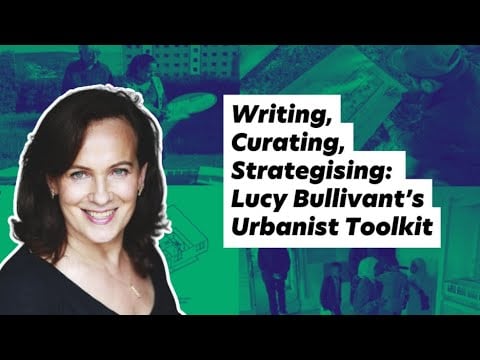
A CPD lesson with Lucy Bullivant, founder of Lucy Bullivant & Associates. Approx. 50 minutes. Watch the video below or listen to the audio.
Who this is for
Architects, students and built environment professionals interested in urban design and place strategy, in writing, publishing and curating, in retrofitting and community engagement, and in the many ways you can contribute to architecture without practising it.
Learning outcomes
By the end of this lesson you will be able to:
- Describe the range of interconnected roles a place strategist and curator plays across the built environment.
- Explain how to structure and research a non-fiction book on urbanism, from first notes to publication.
- Weigh the opportunities and risks of using AI in writing and research, and protect your own authentic voice.
- Outline what makes an exhibition work as "edutainment", and how to assemble one sustainably.
- Apply principles of genuine community engagement to retrofit and public-space projects.
- Recognise how design review panels and place strategies shape public-sector decisions.
1. A portfolio of interconnected roles
Lucy's working life combines curating exhibitions and conferences, place strategy for the public and private sectors, writing, and occasional mentoring. She frames these not as separate careers but as complementary skills that reinforce one another. The throughline is collaboration across disciplines and backgrounds, a value she traces to growing up among architects and landscape architects.
2. Writing Masterplanning Futures
Commissioned by Routledge, Masterplanning Futures took roughly four years and later won recognition as an urban design book of the year. A revised edition reframes the same global subject around the ecological and social pressures that have intensified since, with chapters on Copenhagen, Milan's station-led masterplans, King's Cross, Brisbane and China, replacing top-down masterplanning with a more adaptive, place-specific reading of the city.
3. How to research and write a book on urbanism
Lucy's method treats writing like design: iterative, fact-checked at every step, and endlessly revised. A short, polemical paperback can grow from lateral notes captured on a phone or train; a large reference book is something readers dip into rather than read cover to cover. Her advice: leave the beginning and the end until last, be generous to yourself in early drafts, cut worthy-but-flat paragraphs, and give visuals and sources the same care as the text.
4. AI in writing: marshal the advantages, mitigate the risks
Lucy is cautious rather than dismissive about AI. She points to students unable to defend AI-authored essays, and to live copyright concerns across the creative industries, while accepting that AI can be useful for a downloadable handbook or guide. Her core argument is that bespoke urbanism, like authentic writing, needs a human hand and a genuine voice; cut-and-paste urbanism is already too common.
5. Curating exhibitions as edutainment
Exhibitions, for Lucy, are experiences encountered in real time and physical space. From an early Royal College of Art show on post-war British industry, to the British Council's touring "Space Invaders" on emerging UK practices, to "Kid Size" for the Vitra Design Museum, the recurring principles are clear: let the exhibits speak, keep circulation open rather than forcing a single route, use film and four-dimensional elements for liveliness, and design for visitors who may only have a few minutes.
6. Designing exhibitions sustainably
For "Retrofit Works" at the Museum of the Home, rather than commissioning a new exhibition build, Lucy is reusing a component-based circular partition system designed by Studio Bark, already used by other institutions and stored for repeated reuse. It is a practical demonstration of the retrofit and circular-economy ideas the exhibition itself explores, and of designing for an audience that reaches well beyond the profession without dumbing the content down.
7. Place strategy and design review
Under the banner of consultancy, Lucy's strategy work includes chairing a council design review panel, where applicants, developers and panel members are guided through a democratic, structured critique. Place strategy can mean a cultural prospectus for a business improvement district, or a published place vision for a major regeneration site that serves as a single internal reference point for officers, members and consultants.
8. Community engagement done well
On a project for a local authority in north-east Oslo, a disused kindergarten on a 1950s social-housing estate was retrofitted into a community centre through genuine resident engagement. Creative workshops let residents shape the brief, from a music studio to a cooking club, and some took part in the DIY retrofit alongside trained workers. The work was captured in downloadable how-to guides on good engagement and the pitfalls to avoid.
9. The Temple Bar Trust
As a trustee of the Temple Bar Trust, a charity devoted to architecture and built environment education near St Paul's, Lucy curates a talks programme several times a month and supports education outreach for young people. The historic spaces are hired out to fund the Trust's educational work, and sessions are recorded and shared publicly.
Key terms
- Place strategy: defining a shared vision and direction for a place, often as a published reference for a client's officers, members and consultants.
- Edutainment: content, here exhibitions, designed to teach and engage at the same time, accessible to professionals and the wider public alike.
- Design review panel: a structured, independent process in which expert members assess and constructively critique development proposals.
- Business improvement district (BID): a defined area where businesses fund improvements to local public spaces and services.
- Retrofit: upgrading and adapting existing buildings, rather than demolishing and rebuilding, for better energy and quality-of-life outcomes.
- Polemic: a short, argument-led piece of writing built around a clear position.
Reflective prompts for your CPD record
- Which adjacent skills, such as writing, curating or engagement, could strengthen your own contribution to the built environment?
- Where could genuine community engagement change the brief on a project you are working on now?
- For a building you know, what would a retrofit-first, circular approach make possible rather than a new build?
About the guest
Lucy Bullivant is the founder of Lucy Bullivant & Associates, a London consultancy working in place strategy, curating, artistic direction and public speaking. An author and curator, and an Honorary Fellow of the RIBA, she is also a trustee of the Temple Bar Trust. Episode recorded 2025. Explore the Lucy Bullivant & Associates practice page and Lucy's profile on the Architecture Social directory.
Audio
Video
Industry
Topics
People