
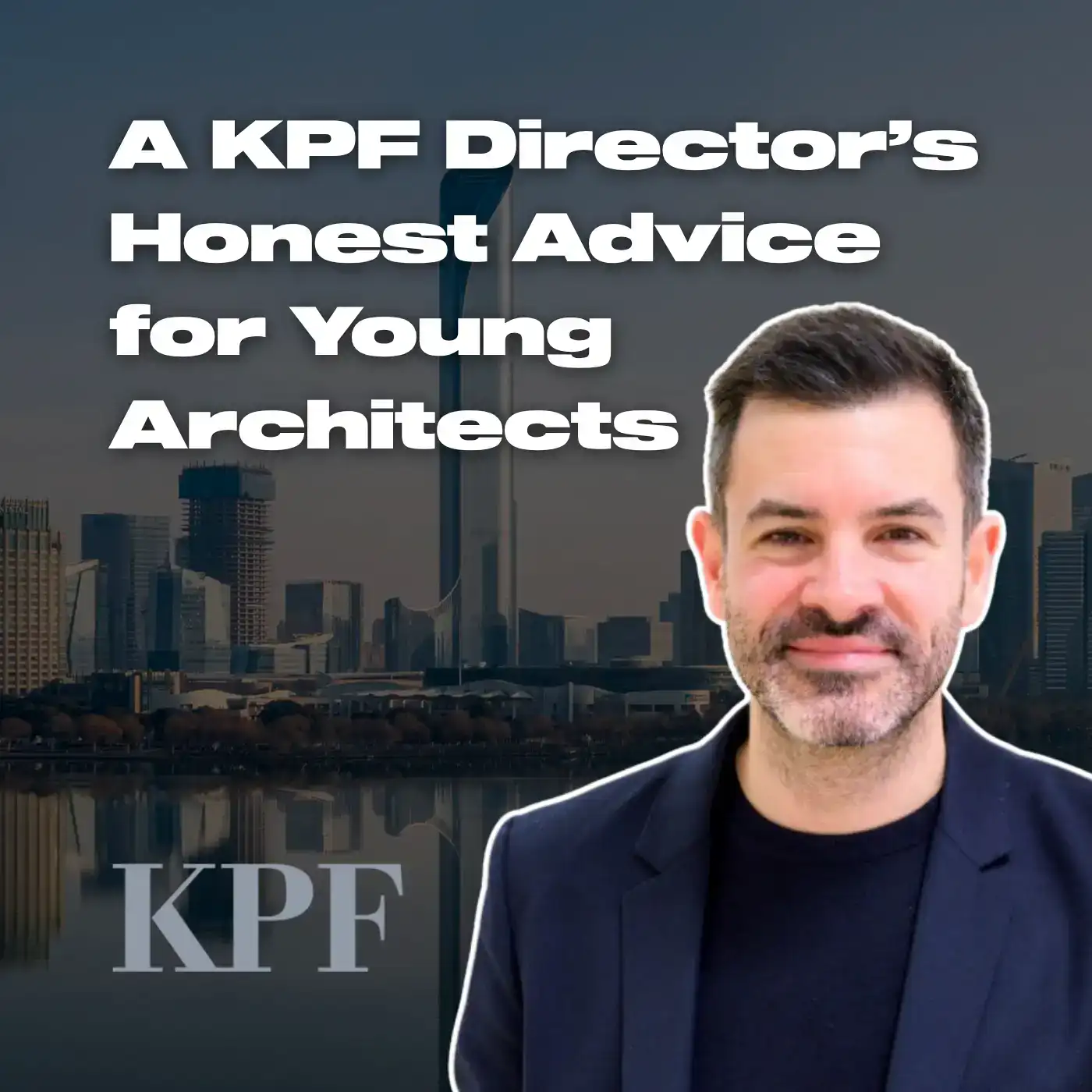
Watch the episode here:
A KPF Director’s Honest Advice for Young Architects
Francesco Casella, Director at KPF, offers a useful counterpoint to one of the profession’s most repeated career myths, that the only way to move forward is to move on. In a sector that often prizes novelty, speed and constant repositioning, his experience points to something steadier. Long term progress, he suggests, comes from proving yourself over time, taking on harder work, and learning how buildings are actually delivered.
That matters for young architects trying to judge their next move. The early years of practice can feel crowded with pressure, from software expectations and portfolio culture to the race for title, salary and visibility. Francesco’s advice cuts through that noise. Skill matters, of course, but so do patience, judgement and the ability to earn trust.
What global practices really look for when they hire
We asked Francesco what makes an applicant credible in a large international practice. His answer points away from polished image making alone and towards clarity of thought.
For young architects, that means a portfolio should do more than look attractive. It should explain how you think, what decisions you made, and where your contribution sat within a team. Big firms are rarely hiring for isolated brilliance. They are hiring for people who can contribute to complex projects, absorb information quickly, and work well with others under pressure.
That is especially important at Part 2 and Part 3 level. Many applicants still overload their portfolios with everything they have done, hoping quantity will signal range. Francesco’s view suggests the opposite. Better to show fewer projects with more precision. What was the brief. What was your role. What constraints shaped the design. What technical or coordination issues did you help resolve.
In other words, evidence beats atmosphere.
Staying in one place only works if your role keeps changing
We asked Francesco why he chose to remain at one practice for so long. The answer was not loyalty for its own sake. It was growth through changing responsibility.
In a large office, staying put can still mean major shifts in experience. An architect may begin as a team member focused on production, then move into coordination, client contact, team management and strategic oversight. If that progression is real, a long tenure can be a strength rather than a warning sign.
This is a useful lesson for younger staff who worry that stability may look like stagnation. The better question is not how often you move, but whether your work is becoming more demanding. Are you seeing new project stages. Are you working with larger teams. Are you learning how decisions get made. Are you trusted with problems that affect programme, budget and quality.
If the answer is yes, depth may be serving you better than constant change.
Software is not the same as design judgement
We asked Francesco about CAD, BIM and the role of digital tools in practice. His position is a timely one. Software matters, but it should never be mistaken for architectural ability.
Too many young professionals are sorted into narrow categories early on. One becomes “the Revit person”, another “the visualisation person”, while broader design and delivery skills lag behind. Francesco’s advice suggests a more balanced route. Learn the tools properly, because large projects depend on technical competence. But do not let software become your only identity.
Practices need people who can draw, coordinate, communicate and think spatially. They need architects who understand how information moves through a project and how decisions made on screen affect consultants, contractors and clients. BIM proficiency is valuable, but it carries more weight when paired with judgement.
For emerging architects, the takeaway is clear. Treat software as part of your toolkit, not as a substitute for authorship or responsibility.
Large teams reward people who bring clarity
Francesco’s career has involved leading major international work and managing teams at scale. We asked what changes when responsibility moves from design contribution to leadership. His answer comes back to clarity.
On large projects, confusion is expensive. Meetings, drawing packages, consultant coordination and internal reviews all depend on clear direction. The architects who rise are often not just the most talented designers, but the people who make the work easier for everyone around them. They communicate well, define priorities, and keep the project moving.
This is an area where younger staff can make visible progress quickly. You do not need a director title to bring clarity. You can write cleaner emails, ask better questions, mark up drawings properly and help the team understand what needs to happen next.
What young architects and assistants can take from this conversation
Francesco’s advice is not to wait passively for a perfect career path. It is to build trust through reliable work, develop technical judgement, and choose roles where responsibility keeps expanding.
Practical takeaways
- Use your portfolio to explain your role, not just the finished image.
- Show evidence of judgement, coordination and communication.
- Learn the software, but do not let it become your whole professional identity.
- Judge a role by whether your responsibility is growing, not only by the job title.
If you are weighing up your next move, use this episode as a prompt to review what your current role is really teaching you. If your responsibility is growing, depth may be more valuable than another quick move. If it is not, it may be time to look for a studio that will stretch you.


Add a comment