
Beech Grove and the Technical Discipline Behind a Listed Building Conversion
David Gilhooley ACIAT is not a recent graduate assembling a portfolio of speculative ideas. He is an Architectural Technologist, technical illustrator and award winning sketch artist with more than 45 years in practice, and he is now preparing to begin an MA at the Royal College of Art. That combination matters. It places him in the unusual position of bringing long technical experience into a fresh academic chapter, while still working with the practical judgement that only comes from years of drawing packages, coordinating trades and solving problems on site.
Beech Grove, Harrogate, is a good example of where that judgement counts. The £5.2 million refurbishment and conversion of a substantial listed property into two luxury apartments and a separate residential annexe was not simply a cosmetic upgrade. It was a technically dense heritage project with the usual competing pressures of conservation, structural intervention, programme control and finish quality. The core challenge was clear. How do you adapt a protected building for contemporary living standards without stripping out the very character that makes it worth retaining in the first place.
Working Within the Limits of a Listed Structure
Projects like Beech Grove are often discussed in terms of prestige, but the day to day reality is more exacting. A listed building carries constraints that affect almost every decision, from structural sequencing to service routes, junction details and the extent of fabric repair. The brief here was to create high end residential accommodation while preserving significant historic elements and respecting the logic of the original building.
That immediately raises a set of architectural questions. How much intervention is necessary to make the building perform as a modern home. Where can new insertions sit without damaging important historic fabric. How do circulation, privacy and servicing work when the existing structure was never intended to contain multiple dwellings. These are not abstract design questions. They are the basis of planning negotiations, technical approvals and contractor coordination.
Harrogate adds its own layer to that discussion. In a town where architectural character remains a strong part of local identity, heritage work is judged not only by conservation officers and consultants, but also by a wider public expectation of quality. A scheme of this type has to be convincing at close range. It has to feel resolved in its proportions, materials and detailing, not merely compliant on paper.
The Drawing Package as a Construction Tool
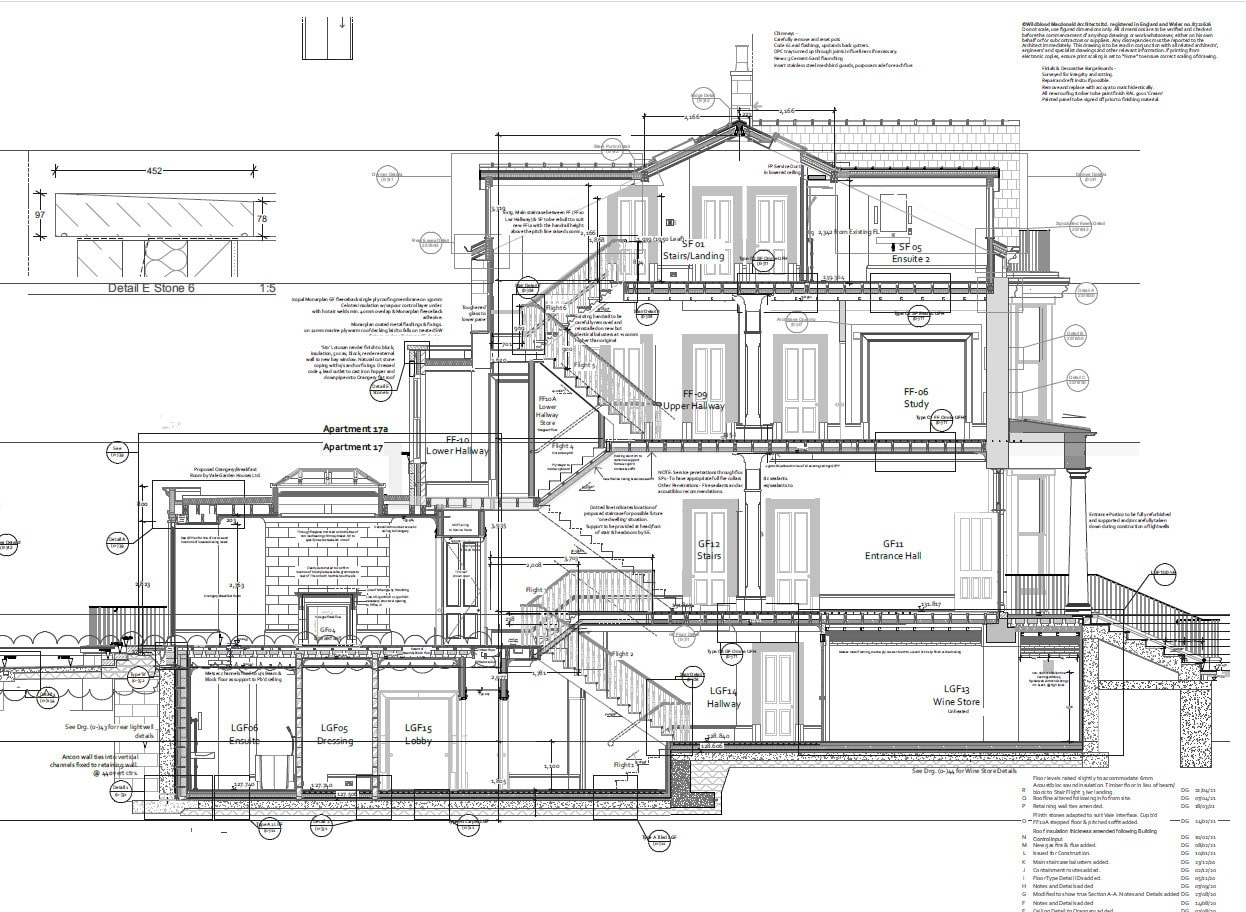
What stands out in David Gilhooley’s role is the breadth of responsibility he carried. He was responsible for the near single handed preparation of the Planning, Building Regulations, Tender and Construction drawing packages, alongside the development and coordination of detailed design information throughout the project. That is serious technical labour, and in many practices it would be split across several hands.
There is a tendency in some parts of the industry to treat drawing production as secondary to authorship. Beech Grove is a reminder that on heritage projects the drawing package is the design. It is where intent is tested against buildability. It is where consultant input is synthesised into information that a contractor can actually use. It is where conservation ambitions either survive contact with the site or fall apart.
On a listed conversion, this means the drawings must do more than describe a finished appearance. They need to anticipate structural openings, floor build ups, moisture risk, tolerances in old fabric, interfaces with retained features and the likely discoveries that occur once work begins. David’s involvement across planning through to construction suggests a continuity that is often missing on complex jobs. That continuity reduces the gap between approval stage promises and site stage reality.
Underpinning, Repair and the Demands of High End Residential Work
The project involved extensive underpinning works, refurbishment of significant historic elements and the integration of bespoke architectural detailing throughout. Those three aspects tell you a lot about the scheme.
Underpinning is disruptive, high risk and expensive. In an old building, it also has consequences for sequencing, protection of retained fabric and coordination with structural engineers and contractors. It is not an isolated technical exercise. It affects everything that follows. If the structural intervention is not properly understood and documented, even well judged conservation work can be compromised.
The refurbishment of historic elements brings a different discipline. Here the job is not to make everything look new. It is to understand what should be retained, repaired or replaced, and to make those decisions with enough precision that specialist trades can act on them. That requires measured observation and patience, which fits closely with David’s wider interests in sketching and hand drawing. His background as an illustrator is relevant not because it is decorative, but because it trains the eye to read junctions, profiles and surface conditions properly.
Then there is the luxury residential aspect. High end housing tolerates very little ambiguity in finish quality. Clients expect clean coordination, discreet services, well resolved joinery and consistent material standards. In a listed building, those expectations can conflict with the irregularities of historic fabric. The technical skill lies in managing that tension without either flattening the character of the building or accepting poor execution as part of the heritage aesthetic.
Why This Matters to the Wider Profession
Beech Grove also says something useful about the position of Architectural Technologists in current practice. This is exactly the kind of project where that discipline shows its value. Heritage conversion is not served well by loose concept work or by over reliance on late stage contractor problem solving. It needs people who can move confidently between design development, technical detailing, specification writing, consultant coordination and site inspection.
David undertook regular inspection, supervision and monitoring of design details during construction to maintain the original design intent. That matters because detail quality on heritage work is rarely protected by drawings alone. It is protected by presence, judgement and the willingness to resolve issues as they emerge. In a market where practices are under pressure on fees, staffing and delivery timescales, that kind of technical consistency is not common enough.
For hiring directors looking for someone with serious experience in technical delivery, heritage adaptation and construction coordination, David Gilhooley ACIAT is worth contacting. You can connect with him on LinkedIn or email him directly at dave6544@gmail.com.
If you are an architecture student, Part I, Part II, Architectural Technologist or practitioner with a project, dissertation or built work that deserves a wider audience, Architecture Social welcomes submissions. Share your work and put it in front of the peers, recruiters and industry readers who are actually paying attention.
What this project shows
Beech Grove is useful because it shows David Gilhooley’s ability to connect a clear design idea with context, users and delivery constraints. It shows the value of technical continuity on heritage projects, from planning and Building Regulations through to construction detail and site monitoring.
For employers reviewing student and graduate portfolios, the lesson is simple. Look past a single hero image and ask how clearly the candidate explains the brief, the site, the decisions and the technical consequences of the proposal.


Add a comment