

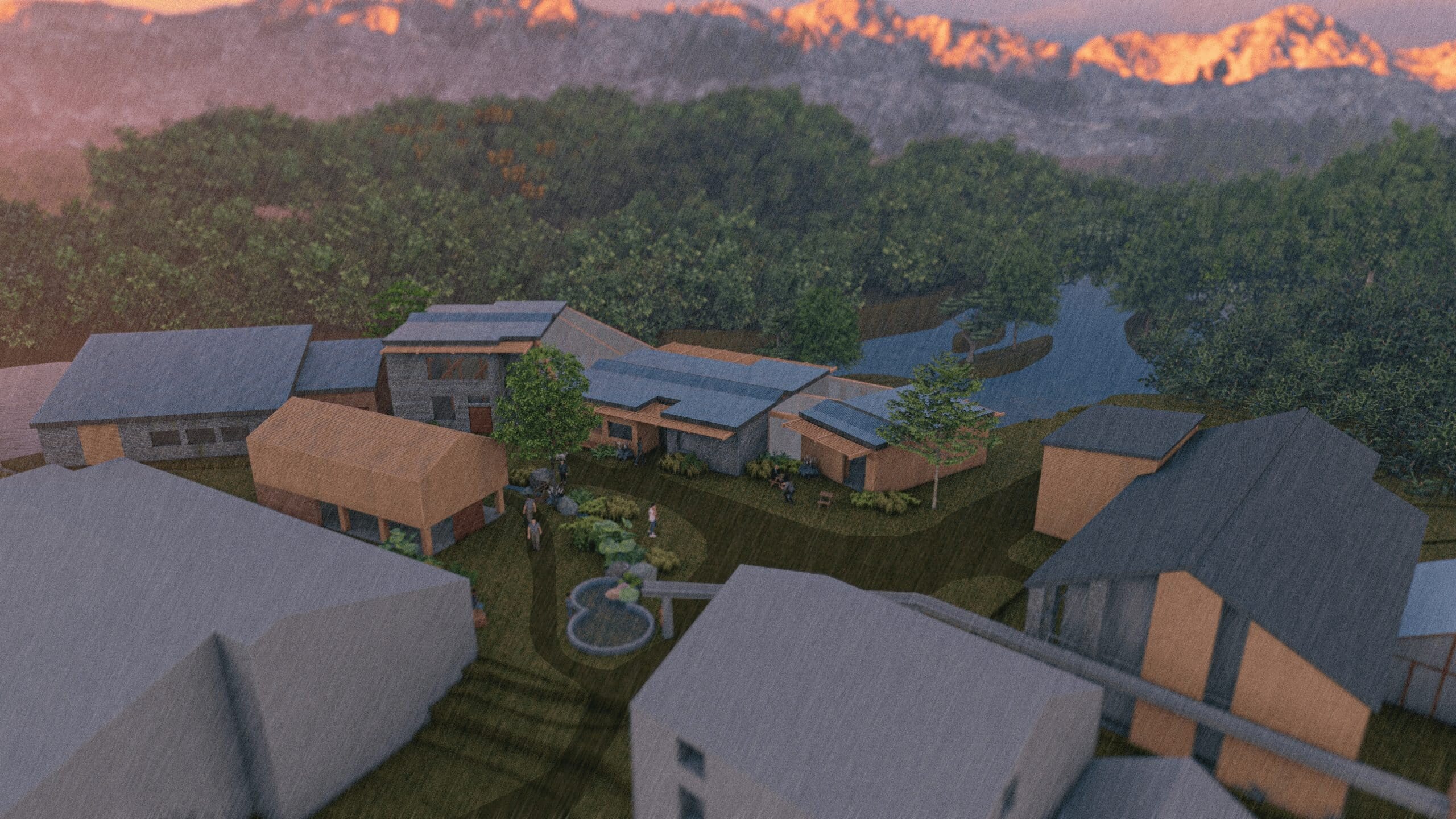
Why Can’t We Live Together by Trevor Bbanda is a communal living architecture thesis about housing pressure, privacy, sustainability and the social life of compact urban homes.
The project is useful because it does not treat community as a vague mood. It asks how people can live closer together while still having dignity, retreat and control over their own space.
Project overview
The original article introduced Trevor as a Part II Architectural Graduate from the University for the Creative Arts in Canterbury. His master’s thesis received a Grade A and centred on the question: Why Can’t We Live Together?
That question becomes a housing proposal built around habitable bedstees: compact, self-contained units arranged within a larger shared structure.
How the living model works
- Compact personal units provide privacy and retreat.
- Shared areas support social life and reduce isolation.
- Cross-laminated timber gives the project a lower-carbon material direction.
- A hardwood-framed structure creates a legible organising system.
- The scheme responds to dense urban housing pressure without abandoning human scale.
Why privacy still matters
Communal living architecture can easily become over-romantic. The strongest schemes understand that people need both community and boundaries.
Trevor’s project is most interesting where it treats privacy as part of the communal model. The best shared housing does not force constant interaction; it creates the right mix of personal space, shared support and everyday visibility.
Portfolio lesson
For a housing thesis, the portfolio should show the unit, the shared spaces and the structural logic together. If the reader cannot understand where someone sleeps, cooks, meets others and gets privacy, the social argument will not land.
Showcase a housing or communal living project
Architecture Social can feature student housing projects where the social idea is backed up by clear plans, sections, material thinking and user logic.
- Show the private unit and the shared system together.
- Explain who lives there and what problem the project solves.
- Use material choices to support the argument, not decorate it.
- Be honest about privacy, maintenance, management and everyday use.
Architecture Social view
Stephen’s recruiter view is that housing portfolios are strongest when they avoid vague social language. A practice wants to see how the concept affects structure, circulation, daylight, thresholds and the daily life of residents.
Next step
Explore more student and housing projects, use the portfolio guide to make your thesis easier to read, or submit your project.
If this project has made you rethink your own portfolio or next move, browse current architecture jobs or contact Architecture Social for a recruiter’s view.


Add a comment