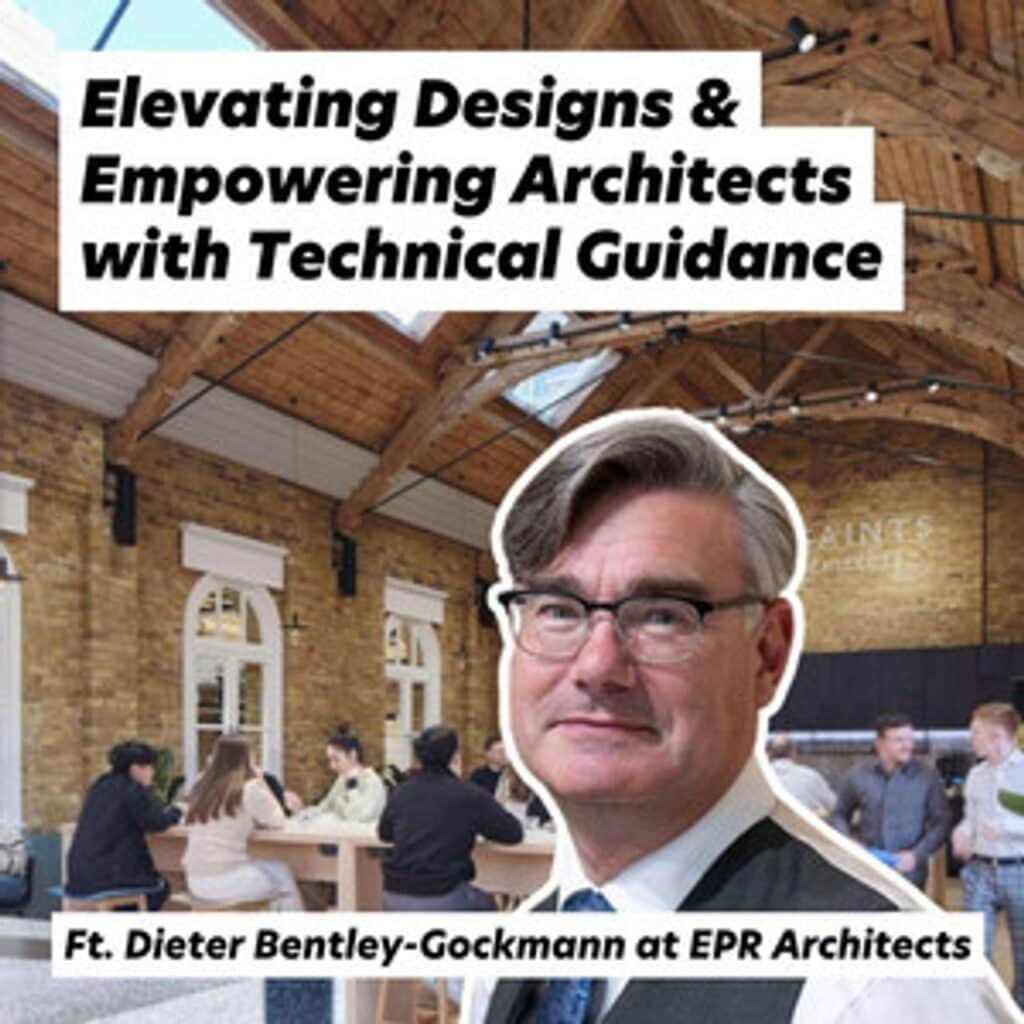
Description
In this Architecture Social conversation (approximately 38 minutes), Stephen Drew speaks with Dieter Bentley-Gockmann, Board Director for legal and technical services at EPR Architects, about how a dedicated technical services function helps studios deliver better, safer and more compliant architecture. The discussion covers in-house technical support, the Building Safety Act and the Principal Designer, a practical approach to continuing professional development, guidance for Part III, and where AI realistically helps in practice.
Prefer to listen elsewhere? Play the episode on Spotify.
Who this is for
Architects and architectural assistants who want to understand technical services and compliance, anyone preparing for Part III, small and medium-sized practices without a dedicated technical team, and designers who want a clearer view of the Building Safety Act and the Principal Designer role.
Learning outcomes
- You will be able to explain what an architectural technical services function does and the value it adds to a design studio.
- You will be able to describe how fire and life safety, sustainability and accessibility are embedded into the design process.
- You will be able to outline the Principal Designer duties introduced under the Building Safety Act and why they matter.
- You will be able to plan continuing professional development around quality and relevance rather than hours alone.
- You will be able to identify practical sources of technical guidance when you do not have an in-house team.
- You will be able to judge where AI can support technical and administrative tasks without replacing reflection and judgement.
What technical services actually does
Dieter describes a central team that supports designers and project runners across the studio, helping them deliver projects properly and, as he puts it, stay on the right side of the law and of gravity. The team began by writing specifications and grew into a broader function spanning technical design, construction best practice, quality and risk management, and professional and legal questions.
From job running to a technical specialism
After running around ten projects in small and medium-sized practices, Dieter looked for a way to specialise. A part-time master's in construction law led to a period working as an expert witness on professional negligence cases, before he returned to a studio environment at EPR to share that experience with designers. It is a useful reminder that an architectural training can lead to several different and valuable career paths.
Designing the place you work
EPR's London studio occupies a former orphanage that later served as the Imperial War Museums archive building. The team took a long lease and retrofitted it, uncovering original tiled floors and the timber structure of the former dining hall, now used as an events and hub space. Designing your own workplace, with around two hundred colleagues holding a view, is both a challenge and a showcase for thoughtful retrofit.
The Building Safety Act and the Principal Designer
RIBA health and safety guidance grew from a gap: plenty of material existed, but little had been written from the architect and designer's perspective. After Grenfell, and following the Building Safety Act and changes to the Building Regulations, that work expanded to cover fire safety, legislation and the duties of the Principal Designer. Understanding these duties is now part of everyday practice rather than a specialist add-on.
A practical approach to CPD
Dieter's advice on continuing professional development is to prioritise quality and relevance over a fixed number of hours. Plan what you need to learn, keep it tied to your live work, and remember that everyday research, reading and problem solving all count. Good guidance can be written to dip in and out of, rather than read cover to cover.
Finding guidance without an in-house team
For smaller practices, Dieter points to journals, professional features, RIBA resources and peer sharing on platforms such as LinkedIn. The key is to stay curious, keep up to date with what is changing in the industry, and find the format, whether reading, listening or diagrams, that works best for you.
Guidance for Part III and professional judgement
The principles of professionalism do not change: understanding the law, behaving ethically, and balancing time, cost and quality when putting a project together. What changes is how we do it. Dieter encourages candidates to connect those principles to work they have already done, since much of Part III formalises practice they have been carrying out without naming it.
Where AI helps, and where it does not
Dieter sees the clearest opportunity for AI in the mundane and technical: schedules, specifications and compliance checks, freeing designers for research and creative work. His caution is that speed can skip the step of analysis and reflection, so teams should protect time to think, talk and sense-check before racing towards an answer.
Key terms
- Technical services: an in-house team supporting designers on technical design, specifications, compliance and risk.
- Building Safety Act: UK legislation introduced after Grenfell that reshaped duties and accountability for building safety.
- Principal Designer: a defined role with duties for managing design risk and safety, including under the building safety regime.
- Part III: the final professional stage of UK architectural qualification, covering practice, law and management.
- CDM: the Construction (Design and Management) Regulations covering health and safety across construction projects.
Reflective prompts for your CPD record
- Where in your current projects could clearer technical or compliance support reduce risk, and how would you access it?
- How well do you understand the Principal Designer duties under the Building Safety Act for the work you do?
- What is one change you could make to plan CPD around relevance and quality rather than hours at the year end?
About the guest
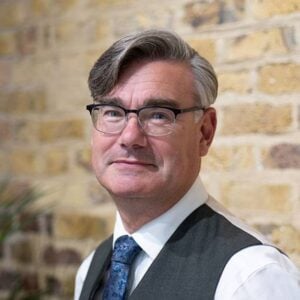
Dieter Bentley-Gockmann is a Board Director at EPR Architects, leading the practice's legal and technical services and its in-house Technical Services team. He studied at the Welsh School of Architecture, Cardiff University, and holds a master's in Construction Law and Arbitration from King's College London. He chairs the RIBA's Regulations and Standards advisory group, sits on the RIBA's Practice and Profession committee, and is the author of RIBA health and safety guidance for architects and designers. Learn more on his Architecture Social profile or visit EPR Architects.
Audio
Industry
Topics
Company
People