
Description
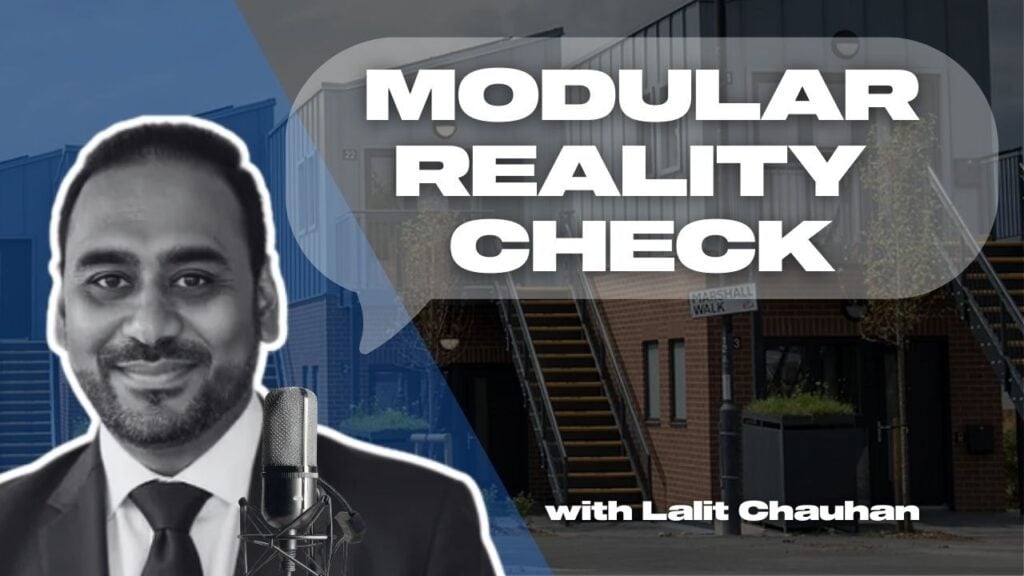
A CPD lesson with Lalit Chauhan FCIAT, Design Director and co-founder of ZEDPods, on the future of zero-carbon modular housing. Approx. 99 minutes. Watch the video below or listen to the audio.
Who this is for
Architects, architectural technologists, Part 1 and Part 2 assistants, and anyone curious about modern methods of construction, low-carbon design and the realities of running a design-led business. It is equally useful for those weighing a move into modular or offsite construction, and for practice owners thinking about sustainable growth.
Learning outcomes
After working through this lesson, you will be able to:
- Explain how volumetric modular construction differs from traditional onsite building, and where most of the work actually happens.
- Describe the air-rights and brownfield model that lets affordable homes sit above car parks and hard-standing land.
- Define the performance gap and identify where it opens up between design intent and delivered building.
- Recognise why a design-led approach, rather than a purely numbers-led one, matters for modular businesses.
- Apply lessons on pricing, fee-setting and feasibility to your own projects.
- Reflect on how to hire, empower and retain people in a fast-moving, factory-based design business.
From India to the Bartlett
Lalit studied architecture in Delhi before moving to the UK to study sustainable urbanism at the Bartlett School of Planning, UCL. He describes immersing himself in London's lecture circuit and treating the city itself as part of the education, building the exposure and experience that a purely theoretical training had not given him.
Starting ZEDPods and the early struggle
ZEDPods was founded in 2016 with no projects in hand. The team developed prototype units and returned to the BRE Innovation Park in Watford, where an early building still stands. Lalit is candid that surviving the first years meant wearing every hat at once: architect, quantity surveyor, contractor and office manager.
Why so many modular businesses failed
Lalit reflects on the wave of well-funded modular companies that collapsed over recent years. His view is that a modular housing business cannot be run on numbers alone; it needs an in-house, design-led understanding of the UK planning system and of what it takes to actually set up a deliverable project, not just a potential one.
The breakthrough projects
An early planning-at-risk project linked to the Bristol Housing Festival gave the studio a real-world proof of concept. The first scheme it delivered, however, came from an NHS request for staff accommodation, designed and built during the early COVID lockdown. Because factories are controlled environments, production could continue while many onsite construction sites were shut, demonstrating the resilience of the modular model.
The air-rights and brownfield model
ZEDPods' business model decouples land and building costs by placing homes on air rights above existing car parks, garages and hard-standing areas. Working on brownfield land inside existing communities means using and upgrading existing infrastructure rather than building out into green areas. The studio describes its approach as bespoke: volumetric and modular, but tailored to each site and its planning context.
Closing the performance gap
A central theme is the performance gap, the difference between the energy and environmental targets a building is designed to meet and what it actually delivers once built, assessed and certified. By taking on the contracting side and bridging design and construction, the studio aims not just to reduce that gap but to eliminate it. Lalit notes that an early 2020 scheme was designed to standards that later aligned with Future Homes Standard, updated Part L requirements and the Building Safety Act.
Pricing, fees and feasibility
Lalit is open about early pricing mistakes: bidding below a comfortable level to win real projects, and learning to charge appropriately as the business matured. He stresses the importance of timing, feasibility studies and honest conversations with clients about fees and risk, rather than undercutting to win work that does not stack up commercially.
Hiring and empowering smart people
As the studio grew, Lalit set out to hire people smarter than himself and to give them a platform to bring new ideas, balanced with a realistic sense of the production pipeline. He describes giving designers constraints rather than a blank page, which he finds sharpens problem-solving and generates better solutions within the discipline of volumetric construction.
The future of modular construction
Looking ahead, Lalit argues that designers must take the lead on climate-conscious, future-facing construction, and that solutions for the future cannot simply be borrowed from the past. He frames modular, low-carbon housing as a long-term response to both housing need and energy poverty.
Key terms
- Volumetric modular: three-dimensional building modules manufactured in a factory and delivered to site largely complete.
- Air rights: the right to build in the space above an existing structure or land use, such as a car park.
- Performance gap: the shortfall between a building's designed performance (often energy) and its measured, in-use performance.
- Brownfield land: previously developed land, often within existing settlements, reused for new development.
- Post-occupancy evaluation (POE): assessment of how a building performs in real use after handover.
- Future Homes Standard / Part L: UK building regulations and standards governing energy efficiency and carbon emissions of new homes.
Reflective prompts for your CPD record
- Where could a performance gap open up on a project you are currently working on, and what could you change in design or delivery to close it?
- How does your practice approach feasibility and fee-setting, and what would you adjust after hearing Lalit's pricing lessons?
- What constraints could you give yourself or your team to sharpen low-carbon design thinking on your next scheme?
About the guest
Lalit Chauhan FCIAT is Design Director and co-founder of ZEDPods, a UK modular build studio delivering zero-carbon, affordable homes for housing associations and local authorities. He is a Fellow of the Chartered Institute of Architectural Technologists. Find out more at zedpods.com.
Audio
Video
Industry
Topics
Company
People


