
Kyrle Co-operative asks a practical question about how young people might live in Ross-on-Wye
Oliver Coupe has just completed his third year at the Welsh School of Architecture, Cardiff University, and his academic work is already showing a clear social focus. A Guernsey born architecture student, he has also gained experience at local Practice The Drawing Room, where his conceptual quarry regeneration project drew attention from The Guernsey Press and positive comments from Guernsey’s Chief Minister. That matters less as a headline and more as a clue to how he is thinking. His projects are not simply formal exercises. They start with a local problem and try to give it spatial form.
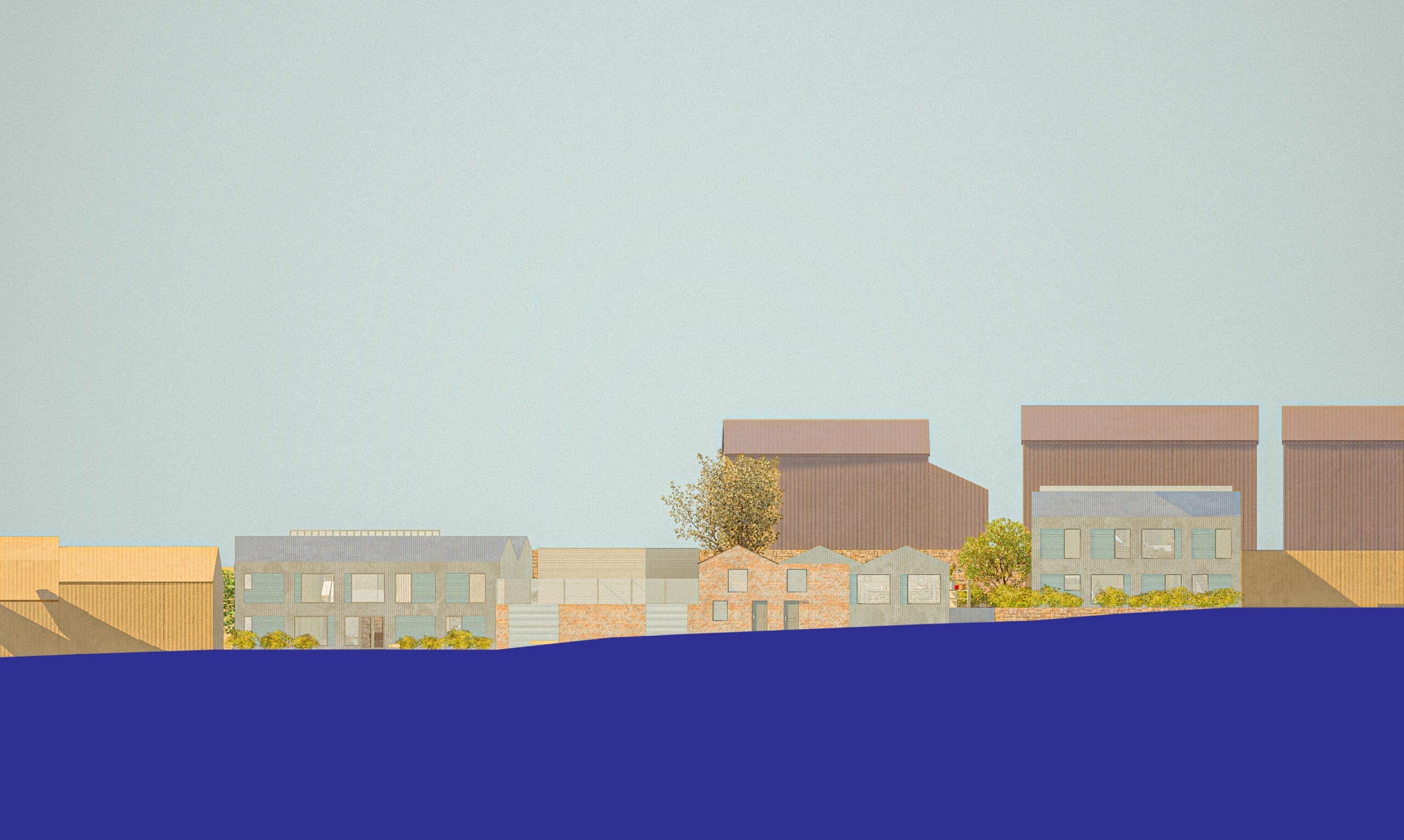
His latest proposal, Kyrle Co-operative, takes on a housing issue that is easy to recognise across many smaller UK towns. Conventional housing models often assume isolated living, duplicated domestic provision, and a pattern of ownership that does little to support community life. In Ross-on-Wye, Coupe’s project asks whether communal housing could offer a more useful model for younger residents, especially in a place where retaining that demographic is becoming harder.
A housing brief shaped by social decline rather than image
The strength of this project is that it does not treat communal living as a lifestyle accessory. Coupe frames it as a response to a specific civic problem, namely the decline of the young community in Ross-on-Wye. That gives the brief a seriousness that many student housing schemes lack. The proposal is not trying to produce a novelty. It is testing whether shared domestic infrastructure can help lower barriers to living independently while also creating a stronger social base.
That distinction is important. Shared kitchens, laundries and living spaces are often presented in student work as abstract communal ideals. Here, they are treated as practical resources. In a town setting, where access to affordable housing and social venues can be limited, pooling some domestic functions can reduce cost, reduce spatial waste, and create casual daily contact between residents. That is a sensible architectural response to a social condition, not a rhetorical one.
Ross-on-Wye is also a useful context for this kind of investigation. Smaller towns across the UK are dealing with a difficult mix of ageing populations, changing local economies, and housing stock that does not always match the needs of younger people. A co-operative model offers one possible answer because it shifts the emphasis from individual consumption to collective use. Architecture has a role here, particularly in how it organises privacy, encounter, and shared responsibility.
Where the proposal succeeds is in the domestic threshold
For communal housing to work, the project has to do more than provide a list of shared rooms. It has to choreograph the thresholds between private and collective space with real care. Kyrle Co-operative appears to understand this. The inclusion of shared living, kitchen and laundry spaces suggests a domestic arrangement where interaction is encouraged through routine rather than imposed through spectacle.
That is often where these schemes stand or fall. If communal space is too detached from day to day life, it becomes underused. If it is too exposed, residents lose the sense of retreat that makes collective living viable in the first place. The best co-living work in practice gives people a clear hierarchy of space, from private rooms or dwellings, to semi-shared circulation and breakout areas, to larger communal rooms that can absorb collective activity. Coupe’s proposal is strongest when read through that lens.
The idea of flexible communal spaces is also well judged. Flexibility in student work can become a vague catch all, but in housing it has a precise meaning. It can allow spaces to support informal gathering, shared meals, study, events, or quiet occupation across the day. In a town seeking to retain younger residents, that flexibility matters because it supports different household structures and different patterns of work. It also allows the building to act as more than a place to sleep. It becomes a small piece of social infrastructure.
Shared amenities as an environmental and economic decision
There is another layer to this project that deserves attention. Shared domestic provision is not only social in ambition. It also has environmental and economic consequences. Reducing the duplication of kitchens, utility areas and appliances can make housing more spatially efficient. It can lower material use at fit-out stage and reduce ongoing energy demand, depending on how the building is detailed and managed. For a generation facing both high living costs and the carbon question, that is not a minor point.
This is where student projects can be at their most useful to the profession. They can test typologies that mainstream housing delivery still approaches cautiously. Co-operative and communal models remain a small part of the UK housing picture, despite longstanding interest from planners, local authorities and community groups. The market is still dominated by standardised products that prioritise individual saleability over collective value. A project like Kyrle Co-operative pushes back against that default position by asking what space is actually needed, what can be shared, and what forms of ownership or occupation better suit contemporary life.
The project would become even stronger with detailed technical development around management, fire strategy, and long-term adaptability, because communal housing always depends on those operational questions as much as it depends on plan quality. That is not a criticism unique to this scheme. It is the reality of this housing type in practice. Good intentions are never enough. Buildings like this need careful governance and clear spatial rules to succeed.
Why practices should pay attention to this line of thinking
For hiring directors and studio leads, Coupe’s work shows a student already thinking beyond object making. He is engaging with housing as a civic and social problem, and using architecture to test a specific response. That is useful in practice, especially at a time when residential design is under pressure to address affordability, loneliness, interdependence, and environmental performance in one move.
Kyrle Co-operative does not pretend that architecture alone can reverse demographic decline in a town like Ross-on-Wye. What it does suggest is that housing can be structured to support community rather than erode it. That is a live question for practices working in housing, regeneration, and community led development across the UK.
If you would like to connect with Oliver Coupe, you can reach him on LinkedIn at www.linkedin.com/in/oliver-coupe or by email at guernseyoliver@gmail.com.
If you are a student, graduate, or architect and would like your work featured, Architecture Social welcomes submissions from across the profession.
What this project shows
The Kyrle Co-operative is useful because it shows Oliver Coupe’s ability to connect a clear design idea with context, users and delivery constraints. It treats communal housing as a specific response to town-centre social infrastructure, affordability and younger residents rather than as a lifestyle image.
For employers reviewing student and graduate portfolios, the lesson is simple. Look past a single hero image and ask how clearly the candidate explains the brief, the site, the decisions and the technical consequences of the proposal.



Add a comment